
If your goal is competitor benchmarking in AI search, you’re trying to answer a simple question with real budget implications:
“When buyers ask AI for recommendations in our category, do we show up, or do our competitors?”
Here are the best picks by use case:
- Best for enterprise-grade depth (visibility + citations + crawler insights): Profound (great when you want to understand how AI talks about you and what it cites at scale).
- Best “analysis → execution” platform (audit + competitor intelligence): Akii (strong for brand vs rivals comparisons plus broader AI search optimization workflows).
- Best mid-market dashboards for prompt tracking + share-of-voice: Peec AI (clean monitoring with transparent tiers; solid for ongoing brand-vs-rivals reporting).
- Best budget option with practical extras (crawler analytics + exports): Promptmonitor (nice fit for SMBs that want “good enough” competitor benchmarking without enterprise pricing).
Best budget-friendly monitoring + GEO-style audits & citations: OtterlyAI (strong prompt tracking + citation analysis, with clear pricing and GEO audit concepts).
📋 Get Listed / Advertisement
We update this guide monthly. Want your tool featured? Contact: [email protected]
Benchmarking (Quick Comparison)
| Tool | Best for | Standout strengths | Pricing snapshot |
|---|---|---|---|
| Profound | Enterprise benchmarking at scale | “Answer Engine Insights,” citations, and AI crawler visibility (“Agent Analytics”) | Custom enterprise pricing (via demo) |
| Akii | Brand vs rivals + optimization workflow | Competitor intelligence, AI brand audit, multi-engine tracking, website optimizer features | Public pricing varies by plan/vendor listing |
| Peec AI | Ongoing prompt monitoring + reporting | Daily prompt runs, visibility/position/sentiment, competitor brand tracking | €89/mo (Starter), €199/mo (Pro) |
| Promptmonitor | Budget competitor monitoring + crawler analytics | Broad model coverage + “AI Search Bot and Crawler Analytics,” CSV exports | $29/mo starter tier listed |
| OtterlyAI | Budget-friendly monitoring + citations/GEO audits | Prompt tracking + link citation analysis + GEO audit concepts | $29/mo Lite, $189/mo Standard |
📋 Get Listed / Advertisement
We update this guide monthly. Want your tool featured? Contact: [email protected].
1. Profound
What it does
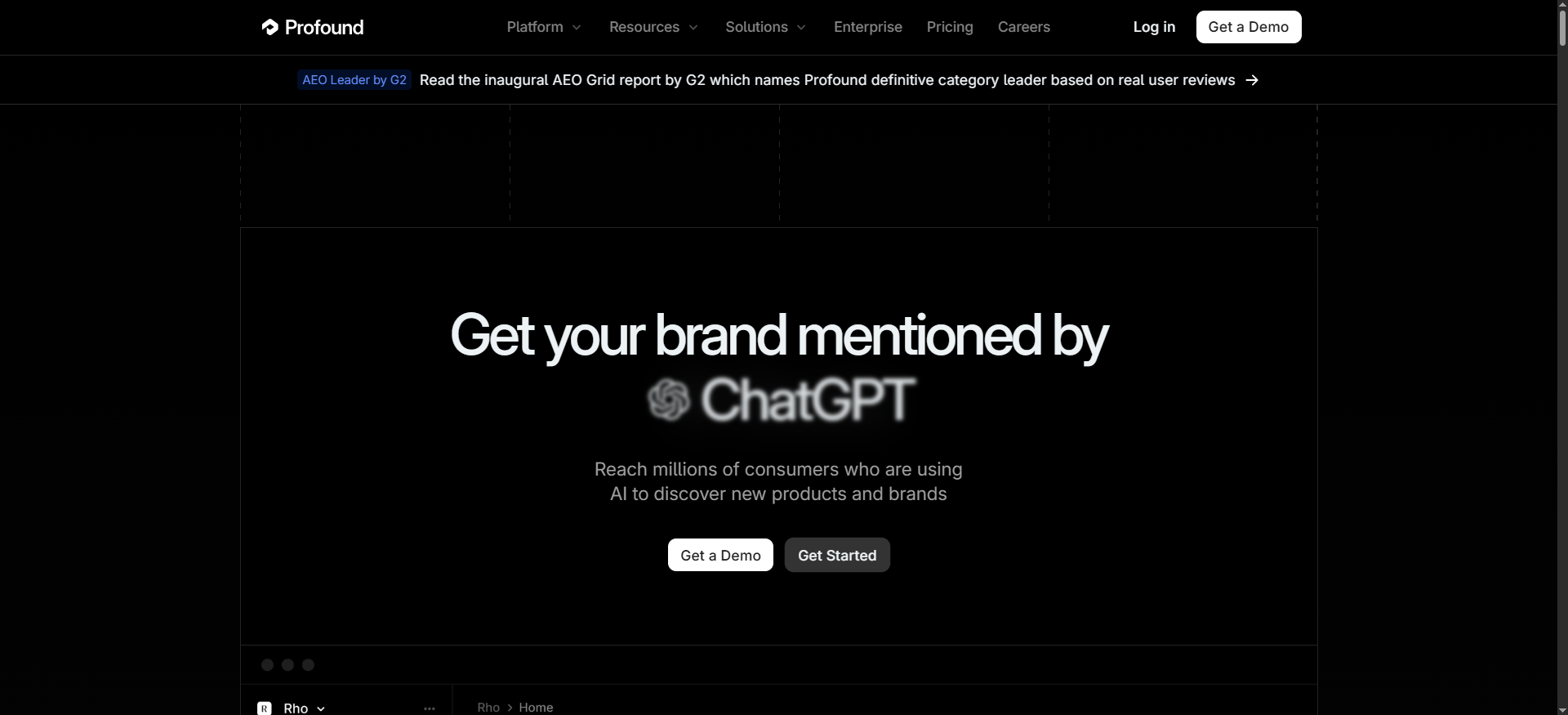
Profound positions itself around understanding how AI talks about your brand: visibility tracking, response analysis, and identifying citations.
Why teams use it
If your benchmarking needs to answer “who is AI recommending and why?” At enterprise scale, Profound is built for that depth, especially where citations and AI crawler behavior matter.
Profound highlights three features that are especially relevant for brand-vs-rivals benchmarking:
- Track Your Presence: how often the brand appears in AI answers
- Uncover Citations: identify which websites influence AI answers about you
- Agent Analytics: visibility into AI crawlers accessing and interpreting your site
What it’s good for
- Enterprise competitive intelligence: many teams, many categories, lots of prompts
- Source-driven benchmarking: “which domains drive competitor recommendations?”
- Technical + content alignment: tie crawlability to citation outcomes
- Global brands: multi-market analysis where the “winner” varies by region
When it’s a good fit
Choose Profound when you have:
- a dedicated SEO + content team
- budget for enterprise tooling
- a real need to connect visibility → citations → site technical health
- stakeholders asking for “why” not just “what”
When it’s not a good fit
Profound can be overkill when:
- you only need basic mention monitoring
- your prompt set is small (under ~50–100 prompts)
- you don’t have bandwidth to act on deep insights
How to use it
A practical setup looks like:
- Define categories you care about (don’t mix unrelated product lines).
- Build competitor cohorts per category (direct rivals + leaders + AI rivals).
- Create prompt clusters mapped to funnel intent (awareness/consideration/evaluation/switching).
- Track visibility + citations weekly, and audit “lost prompts” monthly.
- Pull the citation domains for competitor wins, then create an “authority capture plan”:
- get listed on domains that repeatedly drive competitor wins
- publish content that competes with those domains (when feasible)
Key capabilities to look for
From Profound’s own positioning, pay attention to:
- response-level analysis (“Analyze AI Responses”)
- citation extraction (“Uncover Citations”)
- crawler/bot insights (“Agent Analytics”)
Pricing
Profound’s pricing starts at $99/month.
Free tier?
Profound doesn’t publicly list a free tier or free trial, but it does offer demos.
Downsides / limitations (for competitor benchmarking)
- Cost + procurement friction: enterprise pricing and onboarding can slow time-to-value.
- Operational overhead: deeper insights require a team to translate data into content/PR/technical changes.
- Benchmarking volatility still exists: even with a strong platform, you need good prompt design and consistent re-runs.
2. Akii
What it does
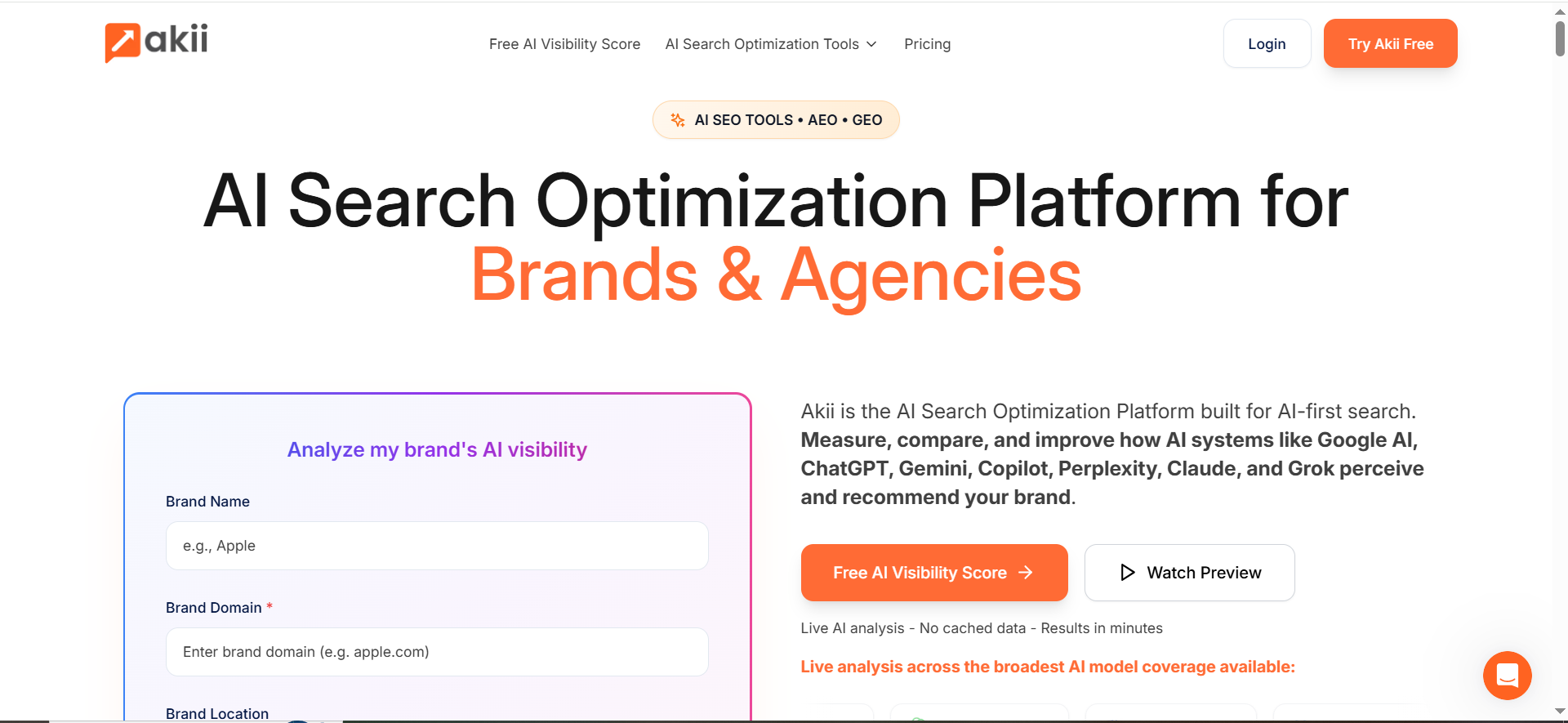
Akii positions itself as a broader AI search optimization platform, not only tracking, but also moving toward execution with audits, competitor intelligence, and website optimization.
Why teams use it
If you want competitor benchmarking that goes beyond a scoreboard, Akii is compelling because it frames competition through:
- AI perception: “how AI systems perceive, describe, and recommend your brand”
- Competitor intelligence: explicitly “brand vs competitors” comparisons and gap analysis
- AI search tracking: how often models mention/recommend/cite your brand
What it’s good for
- Brand vs rivals battlecards: benchmark trust/authority/relevance dimensions
- Cross-engine tracking: Akii lists tracking across Google AI, ChatGPT, Perplexity, and Copilot in one dashboard
- Multi-language benchmarking: Akii notes support for multiple languages, useful if competitors vary by region
- Connecting benchmark → fixes: website optimizer positioning (schema, AI-ready files, technical issues)
When it’s a good fit
Choose Akii when:
- you need competitor benchmarking + recommendations (not just monitoring)
- you want to run an initial audit quickly to establish a baseline
- your team likes a single platform for tracking + “what to do next” workflows
When it’s not a good fit
Akii may not be ideal if:
- you only need lightweight prompt monitoring at the lowest possible cost
- your organization requires deeply validated, internal-data-driven attribution (Akii is more visibility/perception oriented)
How to use it
- Run an AI brand audit to capture baseline perception and gaps.
- Set up competitor intelligence for your direct rival set (3–5 primary competitors).
- Track prompt visibility weekly for each funnel stage prompt cluster.
- Use gap analysis to decide whether wins require:
- content creation (new pages)
- authority building (third-party mentions)
- technical improvements (crawlability, schema, internal linking)
- Re-run competitor comparisons monthly to show movement (exec-friendly).
Key capabilities to look for
- AI Search Tracker (mentions/recommendations/citations over time)
- Competitor Intelligence and “battlecards” style comparisons
- Website optimizer positioning (technical fixes + schema optimization)
Pricing
Akii’s pricing starts at $49/month.
Free tier?
Akii doesn’t offer a free tier, but it does offer a 14-day free trial (and a free AI visibility analysis).
Downsides / limitations
- “All-in-one” tradeoff: broader platforms sometimes sacrifice depth in one module compared to a best-in-class specialist.
- Benchmark clarity depends on prompt design: if your prompt library is weak, your “competitor intelligence” will be noisy.
- Verify scoring methodology: any “visibility score” can be helpful, but you’ll want to understand how it’s calculated before reporting it to execs.
3. Peec AI
What it does
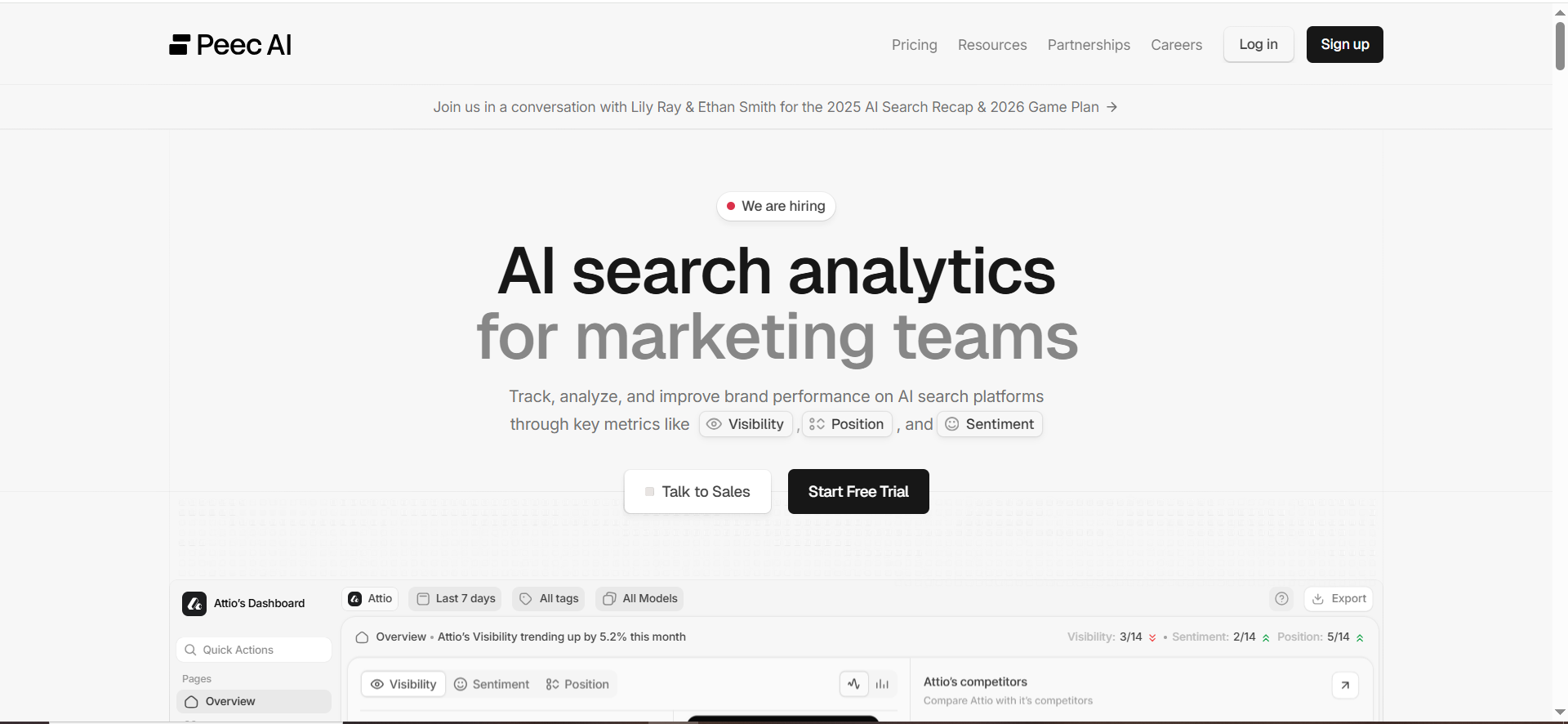
Peec AI positions itself as AI search analytics for marketing teams, tracking brand performance metrics like visibility, position, and sentiment, and enabling you to track how you stack up against other brands.
Why teams use it
Peec is a strong fit for ongoing competitive reporting because it’s explicit about:
- tracking “visibility” metrics and trends
- analyzing large volumes of AI answers per month (depends on plan)
- daily prompt runs across supported models
- adding brands (competitors) so you can compare
On the pricing page, Peec’s plan packaging makes benchmarking predictable: prompt limits, answer volume, and support tiers are clear.
What it’s good for
- Mid-market competitor dashboards: track 3–10 rivals on a recurring cadence
- Prompt discipline: prompt limits force you to build a clean, high-signal library
- Exec updates: weekly/monthly “visibility trending” narrative is easy to communicate
When it’s a good fit
Choose Peec AI if you want:
- transparent pricing and plan limits
- daily monitoring with a known prompt volume
- competitor benchmarking that’s primarily about share-of-voice + sentiment + visibility
When it’s not a good fit
Peec may be less ideal if:
- you need deep technical crawler analytics baked into the platform
- you want a broader “site optimizer” product (instead of monitoring + analytics)
How to use it
- Choose a tight competitor set (3–5) for your first month.
- Build a prompt library across funnel stages (awareness → switching).
- Tag prompts by:
- use case
- industry
- buyer persona
- competitor-comparison prompts
- Establish a baseline month and report:
- overall visibility vs competitors
- category-specific prompt clusters where you win/lose
- sentiment shifts for competitor mentions
- Turn losses into a backlog:
- create “comparison” pages for your worst-performing prompt clusters
- strengthen third-party profiles on sites that are commonly cited
Key capabilities to look for
Peec’s plans emphasize:
- access to key AI platforms (ChatGPT, Perplexity, AI Overviews)
- daily prompt runs
- visibility benchmarking capabilities through tracked prompts/brands
Pricing
Peec AI’s pricing starts at €89/month.
Free tier?
Peec AI doesn’t offer a free tier, but it does offer a free trial (and demos for Enterprise).
Downsides / limitations
- Prompt limits can pinch if you try to benchmark too many segments at once (industry + use case + region).
- Volatility management is still required: you’ll want prompt re-runs and stable reporting windows.
- You still need execution capacity: the platform tells you where you lose, your team still needs to publish and distribute the fixes.
4. Promptmonitor
What it does
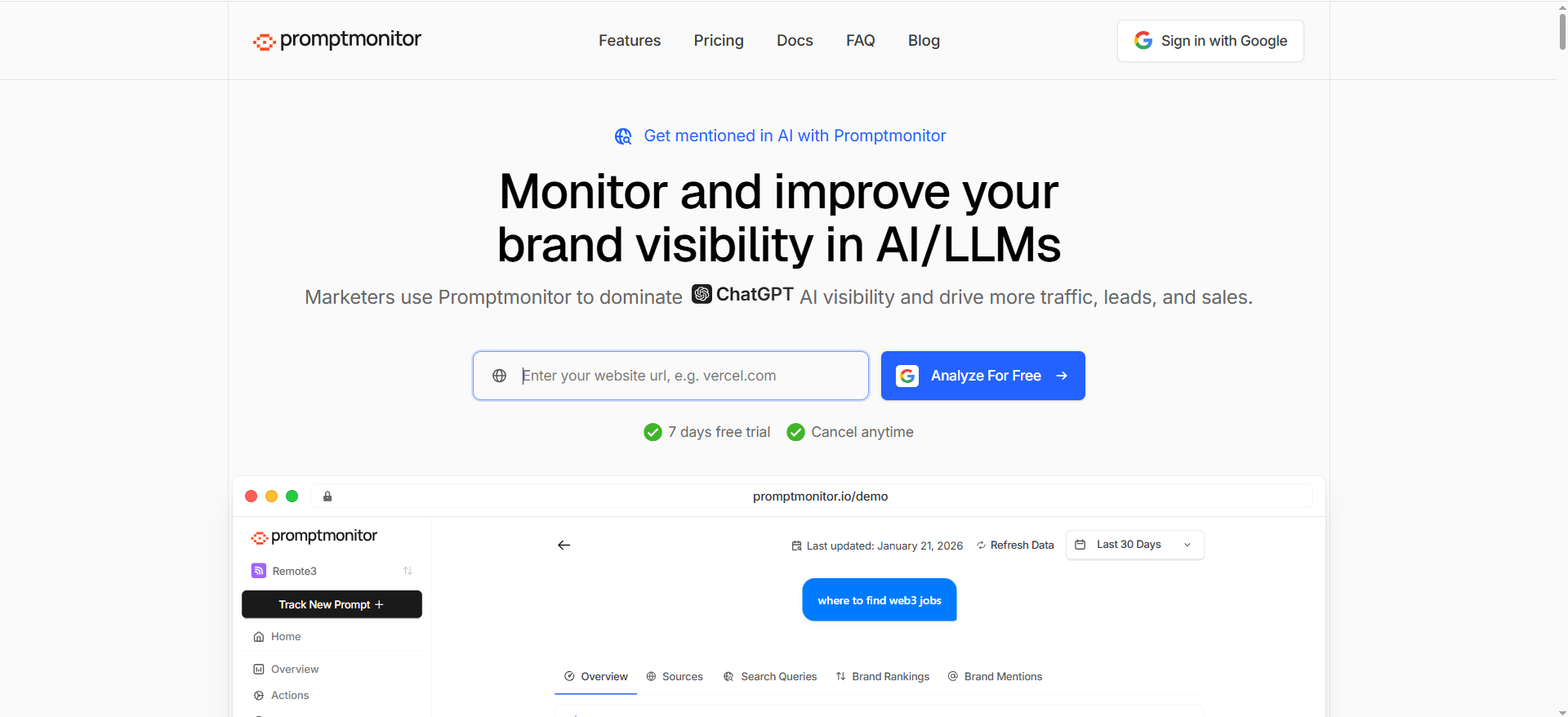
PromptMonitor positions itself as a tool to track and improve company visibility across major LLMs and answer engines, with a strong emphasis on “mentions” and “sources” behind answers.
Why teams use it
Promptmonitor is a practical pick when you want:
- affordable prompt monitoring
- broad model coverage
- exports and reporting
- and a standout feature for some teams: AI Search Bot and Crawler Analytics (helpful for technical benchmarking)
On its pricing section, Promptmonitor lists model coverage and includes “AI Search Bot and Crawler Analytics” in the starter package.
What it’s good for
- Budget “brand vs rivals” monitoring for startups and SMBs
- Technical benchmarking: if you suspect competitors are more crawlable to AI bots
- Operational reporting: weekly email reports + CSV export helps keep stakeholders aligned
When it’s a good fit
Choose Promptmonitor when:
- you need multi-model coverage without enterprise cost
- you want to track both prompt visibility and crawler/bot signals
- your team wants a tool that’s quick to deploy with a smaller prompt library
When it’s not a good fit
It may not be ideal if:
- you need deep enterprise-grade workflows and integrations
- you want very advanced, customized reporting across many markets and brands
How to use it
- Start with a “competitor core set”: pick 3–5 brands.
- Use 25 prompts (or similar) split across:
- 10 category discovery prompts
- 10 comparison prompts (“Brand vs Rival”)
- 5 switching prompts (“alternatives to Rival”)
- Track daily, but report weekly (to smooth fluctuations).
- Use crawler analytics to spot technical gaps:
- Are AI bots hitting your key pages?
- Are they missing important sections competitors have?
Key capabilities to look for
- broad AI platform coverage (listed in plan: ChatGPT, Claude, Gemini, Perplexity, etc.)
- crawler analytics and exports
Pricing
Promptmonitor’s pricing starts at $29/month.
Free tier?
Promptmonitor doesn’t offer a free tier, but it does offer a 7-day free trial (and a free analysis tool/demo).
Downsides / limitations
- Depth vs affordability: you may not get the same enterprise-grade depth of citations + integrations as higher-end platforms.
- Prompt cap = prioritization: you must pick high-value prompts; otherwise results won’t map to pipeline reality.
- Still requires “source work”: when rivals win due to third-party citations, you’ll still need PR/outreach + content strategy to change that.
5. OtterlyAI
What it does
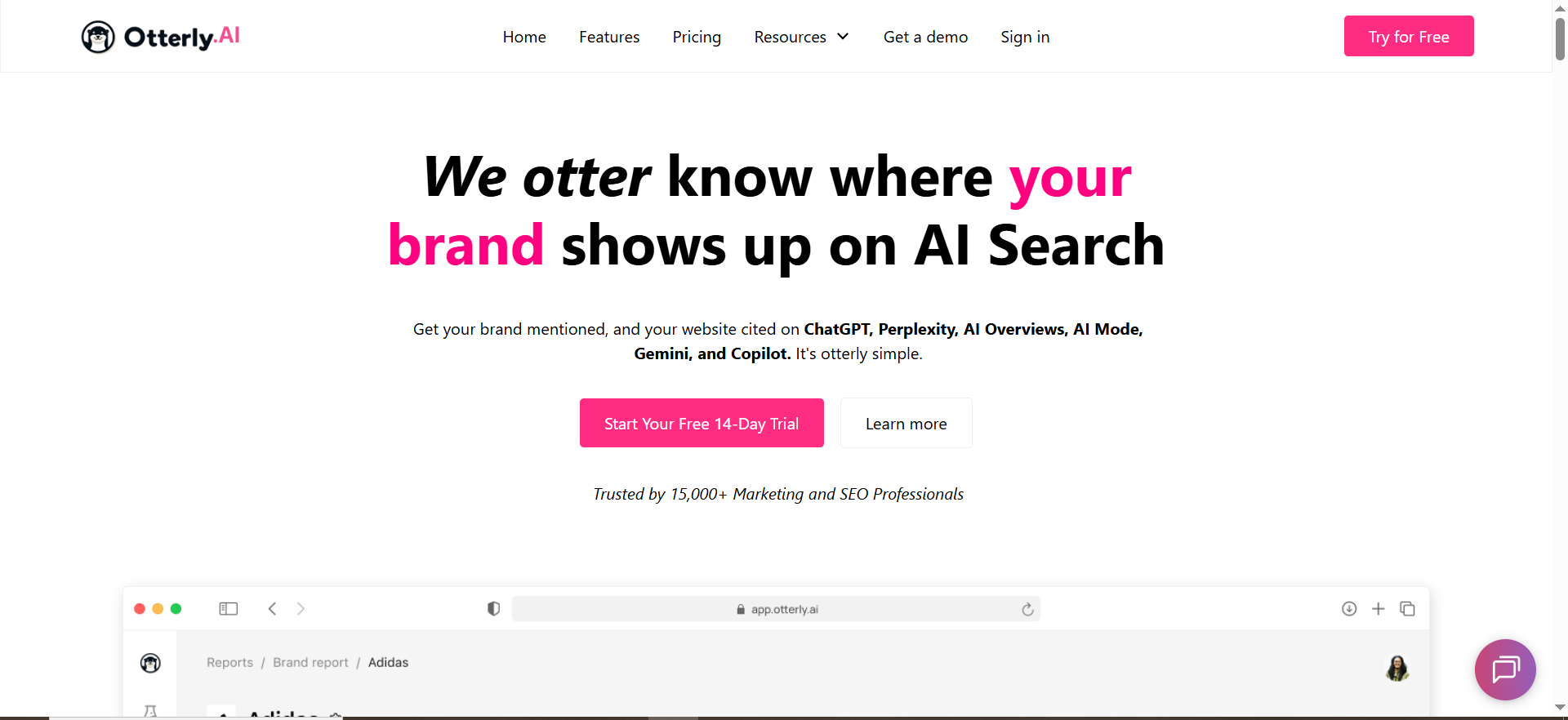
OtterlyAI describes AI visibility tracking as monitoring how often your brand appears in AI-generated answers across platforms like ChatGPT, Google AI Overviews, Perplexity, and Copilot, and compiling that into dashboards with share-of-voice style metrics.
Why teams use it
OtterlyAI is especially useful for competitor benchmarking because it leans into:
- prompt libraries that mirror real buyer questions
- competitive benchmarking reports and trend visibility
- citation/link analysis (what sources drive answers)
- GEO audit concepts (helpful framing: not only “did we show up?” but “what should we fix?”)
What it’s good for
- Budget-friendly “share of AI voice” monitoring
- Citation-driven benchmarking for teams that want to pursue PR/authority wins
- Multi-country benchmarking (useful when competitive landscape varies by region)
When it’s a good fit
Choose OtterlyAI if you want:
- clear pricing with multiple tiers
- multi-engine coverage
- an emphasis on citations and GEO-style audits without enterprise pricing
When it’s not a good fit
It may not be ideal if:
- you need highly customized enterprise workflows (SSO, deep governance)
- your benchmark program spans dozens of product lines and markets with complex stakeholder needs
How to use it
- Set up prompt clusters for each funnel stage.
- Include comparison prompts (Brand vs Rival) and “alternatives to Rival.”
- Track daily, but report on a 7-day rolling basis.
- Use citation analysis to build a “source capture list”:
- domains that repeatedly cite competitor wins
- pages you can upgrade or create to become citable
- Run a GEO audit and turn it into a backlog (content + authority + technical).
Key capabilities to look for
From OtterlyAI’s pricing page highlights and positioning:
- prompt research tooling
- brand visibility index
- link citation analysis and GEO audits
Pricing
OtterlyAI’s pricing starts at $29/month.
Free tier?
OtterlyAI doesn’t offer a free tier, but it does offer a free trial.
Downsides / limitations (for competitor benchmarking)
- Prompt volume constraints: competitor benchmarking gets expensive if you try to track too many segments at once
- Execution still matters: benchmarking won’t change outcomes unless you commit to content/authority/technical improvements.
- You’ll want a measurement discipline: stable prompt sets and rolling averages.
What “competitor benchmarking” means in AI search (and why it’s different than SEO)
Traditional competitor benchmarking in SEO usually looks like:
- who outranks you for keywords
- who has stronger backlink profiles
- who wins SERP features
- who dominates category pages and listicles
AI search competitor benchmarking is different because your “rank” often isn’t a blue link, it’s:
- a mention (“Brand X is the best option for…”)
- a recommendation (“Use Brand Y because…”)
- a comparison (“Brand A vs Brand B…”)
- a citation (which sources the model uses to justify the answer)
- a shortlist (the “top 3–5 tools” pattern)
And unlike classic rankings, answers vary by model, region, prompt wording, and time. Tools like OtterlyAI describe this category as AI visibility tracking across platforms like ChatGPT, Google AI Overviews, and Perplexity.
The 5 metrics that actually move decisions
If you only track “do we show up, yes/no,” you’ll miss why rivals win. For competitor benchmarking, focus on these five:
- Mention rate (coverage): Out of all tracked prompts, how often does your brand appear at all?
- Share of AI voice (SOV): When the model gives a list of options, how often are you included compared to your competitor set?
- Prominence / position proxy: Are you mentioned first? In the top cluster? Or buried as an “also consider”?
- Citation share (source footprint): Which domains are being cited when competitors are recommended? (Your content? Competitor content? Review sites? Wikipedia? G2? GitHub? News?)
- Sentiment + framing: Is AI describing you as “best for enterprise,” “cheap but limited,” “hard to set up,” etc.?
What to track across engines
Different engines behave differently:
- ChatGPT-style assistants often synthesize from general knowledge and (depending on product mode) may provide fewer explicit citations.
- Perplexity-style engines lean harder on citations and sources, which is gold for competitor benchmarking because you can trace why the model recommends a rival.
- Google AI Overviews / AI Mode can shift visibility away from classic organic results, so competitors may “win” even if they don’t outrank you in the traditional SERP.
That’s why most modern AI visibility tools emphasize multi-engine prompt execution and citation capture.
The new competitive AI-first era: “Recommended brands” + “cited sources”
Here’s the most important mindset shift:
In AI search, you don’t only compete with brands. You also compete with sources.
If AI repeatedly cites:
- “Top 10 tools” listicles where you’re missing
- review directories where competitors have stronger profiles
- documentation pages that mention competitor integrations
- community posts that recommend rivals
…then your benchmarking project should track both:
- Which brands are winning?
- Which sources are causing them to win?
The best tools make this visible by surfacing citations and/or the websites used to answer questions. Profound, for example, positions “Uncover Citations” as a key capability.
The benchmarking workflow
If you want benchmarking to be actionable (not just a dashboard), use this workflow. It’s designed for “brand vs rivals” evaluation, the exact decision behind most tool purchases.
Step 1: Build your competitor set (true rivals vs category leaders vs “AI rivals”)
For AI search benchmarking, use three competitor buckets:
- Direct rivals: Companies you lose deals to today (sales intel + churn reasons + “competitors” pages).
- Category leaders: The brands AI is most likely to recommend as “default safe choices.”
- AI rivals: Brands that show up in AI answers, even if your sales team doesn’t see them as competitors yet.
Why this matters: AI answers often surface “adjacent” products (a broader category) and those can quietly become your pipeline competitors.
Pro move: Build two sets:
- Set A (Board report): 3–5 names max
- Set B (Ops set): 10–20 names, includes up-and-comers and “AI rivals”
Step 2: Build a prompt library (intent buckets + query fan-out)
Competitor benchmarking fails when prompts are random. You want prompts that mirror buyer intent.
Use four intent buckets (and put 25–50 prompts in each, depending on budget):
Bucket 1 — Category discovery (awareness)
Examples:
- “Best [category] tools for [industry]”
- “What is the best alternative to [category leader]?”
- “Top platforms for [job-to-be-done]”
Bucket 2 — Consideration (shortlist building)
Examples:
- “[Brand] vs [Competitor]: which is better for [use case]?”
- “Best [category] for [company size]”
- “Best [category] with [integration]”
Bucket 3 — Evaluation (decision support)
Examples:
- “Pros and cons of [Brand]”
- “Is [Brand] good for enterprise security / compliance?”
- “Pricing of [Brand] vs [Competitor]”
Bucket 4 — Switching (high commercial intent)
Examples:
- “Alternatives to [Competitor]”
- “Replace [Competitor] with [Brand]—migration guide”
- “Is [Brand] cheaper than [Competitor]?”
Then add fan-out modifiers:
- industry (SaaS, eCommerce, healthcare)
- size (startup, mid-market, enterprise)
- region/language
- “best for” constraints (budget, security, API, reporting)
Step 3: Run a baseline + normalize volatility
AI answers fluctuate. If you run a prompt once, you’ll get false positives and false negatives.
Instead:
- run prompts on a schedule (daily/weekly)
- compare rolling averages (e.g., 7-day and 28-day windows)
- tag prompts by intent bucket so you don’t mix “awareness” wins with “switching” wins
Step 4: Diagnose “why competitors win”
When competitors win, you want to label the reason:
- Citation-driven: model cites sources where competitor is listed, reviewed, or referenced
- Entity-driven: competitor is strongly associated with key concepts (integrations, standards, buzzwords)
- Authority-driven: competitor has stronger third-party mentions (press, analyst reports, communities)
- Coverage-driven: competitor has content matching buyer questions (pricing pages, comparisons, integration docs)
- Technical-driven: competitor pages are more crawlable / indexable for AI bots
Tools that expose citations and crawler behavior make this step much faster.
Step 5: Turn benchmarking into an action plan
A good benchmark report always produces a backlog with owners:
Content backlog (SEO + GEO)
- “Best for” pages
- comparison pages (Brand vs Competitor)
- integration landing pages
- pricing explainers (transparent, structured)
- use-case pages (industry + job-to-be-done)
PR / authority backlog
- review site profile upgrades
- analyst briefings
- guest posts / partnerships on “cited domains”
- founder quotes and original data that earns citations
Technical backlog
- structured data cleanup
- internal linking to “money pages”
- crawl rules for AI bots (where relevant)
- page performance and accessibility
Entity / narrative backlog
- update how your brand is described across the web (consistent category language)
- reinforce associations: “Brand = [category] for [persona]”
- improve “trust signals” (security pages, compliance docs, third-party validation)
Step 6: Choose cadence and reporting format
- Weekly: operations + experiments (prompt-level changes, quick wins)
- Monthly: executive summary (share-of-voice vs top 3–5 competitors)
- Quarterly: strategic shifts (category narrative, big content programs, PR campaigns)
How to choose the right tool (decision matrix)
Use these questions to choose fast:
1) How many prompts do you realistically need?
- 25–50 prompts: Promptmonitor or OtterlyAI can cover the basics.
- 100–300 prompts: Peec (Pro) or Otterly (Standard/Premium) becomes viable.
- 300+ prompts across multiple categories/markets: consider enterprise platforms like Profound, or a broader platform approach like Akii depending on your needs.
2) Is benchmarking “mentions” enough, or do you need citations?
If you’re trying to change competitive outcomes, citations matter because they tell you what to influence.
- Strong citation emphasis: Profound, OtterlyAI
- Mixed/monitoring emphasis: Peec, Promptmonitor
3) Do you need technical crawl insights?
If you suspect competitors win because they’re more accessible to AI crawlers:
- Profound highlights crawler visibility via Agent Analytics
- Promptmonitor includes AI Search Bot and Crawler Analytics in the plan
4) Do you want a “platform” or a “tracker”?
- If you want tracking only: Peec / Otterly / Promptmonitor
- If you want audit + competitor intelligence + optimization workflows: Akii
Common pitfalls (and how to avoid bad benchmark data)
Pitfall 1: Using prompts that don’t match buying behavior
Fix: build prompts from:
- sales calls
- competitor comparison pages
- “alternatives” queries
- G2/Reddit/community language (carefully)
Pitfall 2: Measuring once and calling it truth
Fix:
- run prompts on a schedule
- use 7-day and 28-day averages
- separate reporting by intent buckets
Pitfall 3: Benchmarking too many competitors at once
Fix:
- 3–5 for executive narrative
- expand later for ops detail
Pitfall 4: Confusing “being cited” with “being chosen”
Fix:
- track both brand mentions and source citations
- build actions for each:
- citations → PR/outreach + content updates
- mentions → entity/narrative + comparison pages
Pitfall 5: Treating benchmarking as a dashboard project
Fix:
Every monthly report should end with:
- 3 “defend” actions (protect your wins)
- 3 “attack” actions (take competitor prompts)
- 3 “expand” actions (new prompt clusters you’re not covering)
How to track brand mentions in ChatGPT vs competitors?
To track brand mentions in ChatGPT (and similar assistants) versus competitors, you need a method that handles two realities:
- ChatGPT outputs vary based on prompt wording, timing, and model mode.
- ChatGPT often doesn’t always provide citations, so you need a benchmarking approach that’s built on repeatability and structured extraction, not one-off checks.
Step 1: Build a controlled prompt set (your “benchmark library”)
Create 25–100 prompts that mirror actual buyer language, split into intent buckets:
- Category discovery: “best [category] tools for [use case]”
- Comparison: “[Your Brand] vs [Competitor] for [use case]”
- Evaluation: “pros/cons of [brand]”
- Switching: “alternatives to [competitor]”
Then add modifiers you care about:
- industry (SaaS, eCom, healthcare)
- company size (startup, enterprise)
- region (US/UK/AE/etc.)
- constraints (budget, compliance, integrations)
Step 2: Define what “a mention” means
Decide in advance:
- Count a mention only if it’s a brand/product name?
- Do you count parent company names?
- Do you count “implied” mentions (e.g., “the tool by X”)?
Recommended: track three states:
- Not present
- Mentioned
- Recommended (explicitly advised / in shortlist)
Step 3: Normalize variability with re-runs
Instead of running each prompt once:
- run the same prompt multiple times over a window (daily/weekly)
- report using rolling averages (7-day and 28-day)
- only call a “win/loss shift” when it persists across multiple runs
Step 4: Capture competitor context, not only your mention
For each response, extract:
- which brands are listed
- which brand is #1 / top 3
- the reasons the model gave (phrases like “best for…”)
- negatives (“expensive,” “limited,” “hard to set up”)
This is what turns a “mention tracker” into competitor intelligence.
Step 5: Track across engines, not only ChatGPT
If you only track ChatGPT, you’ll miss:
- citation-driven wins in Perplexity-style answers
- SERP-integrated shifts in Google AI Overviews/AI ModeA real competitor benchmark compares engine-by-engine results.
AI search monitoring vs rank tracking: What’s the difference?
Rank tracking answers:
“Where do we rank for keywords in Google?”
AI search monitoring answers:
“Do AI systems recommend us, and which sources are influencing those recommendations?”
Rank tracking (classic SEO) is about:
- keyword positions
- SERP features
- changes in organic visibility
- traffic potential
- backlink correlation and content decay
AI search monitoring is about:
- brand mentions and recommendations in AI answers
- share of AI voice vs competitors
- prompt-level performance (which buyer questions you win/lose)
- citations and sources (what the model uses to answer)
- sentiment and framing (“best for enterprise,” “budget tool,” etc.)
- engine variability (ChatGPT vs Perplexity vs Google AI Overviews)
Why this matters for competitor benchmarking
In AI answers, your competitor can “win” even if:
- you outrank them for traditional keywords
- you have more backlinks
- your content is “better SEO’d”
Because the AI might be:
- drawing from third-party review sites that favor them
- using listicles you’re missing from
- leaning on a source where they’re mentioned more strongly
That’s why AI monitoring tools often emphasize citation tracking, because it tells you which sources you must influence to beat competitors.
How many prompts do I need to monitor competitors?
You need enough prompts to be statistically meaningful and operationally manageable.
Here’s a practical framework:
Minimum viable competitor benchmark: 25 prompts
Use this when you’re starting out or budget-limited.
- 10 prompts: category discovery
- 10 prompts: comparisons (Brand vs Rival A/B/C)
- 5 prompts: switching (“alternatives to Rival”)
This is enough to get directional share-of-voice and identify obvious gaps.
Strong benchmark: 60–120 prompts
Best for most growth teams.
Split like:
- 30% discovery
- 40% consideration/comparison
- 20% evaluation
- 10% switching
Add segmentation:
- 2–3 key industries
- 2 size tiers (SMB vs enterprise)
- 1 region variant if relevant
Mature benchmark: 300+ prompts
Best for enterprise and agencies managing multiple categories/markets.
This is when you:
- track multiple product lines
- track multiple countries/languages
- maintain “board set” (top 3–5 competitors) + “ops set” (10–20 competitors)
The decision rule
If your prompt set doesn’t represent:
- your highest-value use cases
- your highest-converting comparisons
- your most important regions/verticals
…then your benchmark will be “interesting,” not useful.
How to improve AI visibility when rivals get mentioned?
When rivals get mentioned and you don’t, don’t guess, diagnose the reason and choose the right fix. Most competitor wins come from one (or more) of these drivers:
1) Citation-driven wins
What it looks like: AI cites sources where your competitor is listed (review sites, “best tools” posts, community threads).
Fixes:
- get included in the cited “top X” lists
- upgrade your presence on review directories (categories, features, screenshots, FAQs)
- pitch authors/editors to add your tool (with proof: customer stories, benchmarks)
- publish a superior “best for X” page that becomes citable
2) Coverage-driven wins (you don’t have the page AI needs)
What it looks like: AI answers questions you haven’t covered clearly, pricing, integrations, migration, compliance, comparisons.
Fixes:
- create comparison pages: “Brand vs Competitor”
- build integration landing pages (and docs that explain “how”)
- publish pricing explanation pages (transparent ranges + what drives cost)
- add “best for” landing pages (industry/use case)
3) Entity/narrative wins (AI “associates” competitor with your category)
What it looks like: competitors are described as “the standard,” “market leader,” “best for enterprise,” etc.
Fixes:
- align your messaging across the web (homepage, press, profiles)
- reinforce associations through consistent language (“[Brand] is the [category] for [persona]”)
- earn third-party mentions using that positioning (PR, podcasts, partnerships)
4) Trust wins (reviews, security, reputation)
What it looks like: AI recommends competitors as “more trusted,” “more secure,” “more established.”
Fixes:
- strengthen security/compliance pages (SOC2/ISO, etc.)
- add case studies with recognizable logos
- publish original research (data that gets cited)
- increase third-party validation signals
5) Technical wins (crawlability/access)
What it looks like: competitor content is more discoverable or accessible to crawlers/agents.
Fixes:
- improve internal linking to money pages
- ensure key content isn’t hidden behind scripts/blocked resources
- fix indexing/crawl issues
- use structured data where relevant
Simple action plan:
For each “lost prompt,” record:
- Which competitor won?
- Why (citation, coverage, trust, entity, technical)?
- What’s the one asset you’ll build or influence to flip the result?
Competitor benchmarking dashboard KPIs for AI search?
A useful competitor dashboard should serve two audiences:
- Execs: “Are we winning vs rivals over time?”
- Operators: “Which prompts and sources do we need to fix to win more?”
Executive KPIs (monthly)
- Share of AI Voice (SOV): % of tracked prompts where your brand is recommended vs competitors
- Mention rate: % of prompts where you appear at all
- Top-3 inclusion rate: % of prompts where you appear in the shortlist
- Sentiment index: net-positive framing vs competitor set
- Trend lines: 7-day/28-day change vs last period
Operator KPIs (weekly)
- Prompt cluster wins/losses: performance by intent bucket (discovery vs switching)
- Competitor “steal” list: prompts where competitor A wins consistently
- Citation share: which domains are most often cited when competitors win
- Your citation footprint: how often your domain is cited (and for which prompts)
- Volatility score: how often answers change for the same prompt (confidence metric)
Best practice dashboard structure
- Overview tab: SOV and trends vs top 3–5 rivals
- Engine tabs: ChatGPT vs Perplexity vs AI Overviews
- Prompt cluster tab: wins/losses by category + intent
- Sources tab: top cited domains, gaps, and opportunities
- Action backlog tab: linked actions per lost prompt (owner + due date)
Multi-country AI visibility competitor tracking?
Multi-country competitor tracking is where AI benchmarking gets tricky, because AI answers can vary by:
- language and spelling
- region-specific competitors
- local citations and sources
- regulations, shipping, pricing, availability
- local review sites and publications
How to do it correctly
1) Separate markets into their own prompt libraries
Don’t reuse the same prompt set globally. Create a core library, then localize:
- language
- local slang and buyer phrasing
- local compliance and integration needs
2) Build a competitor set per market
You’ll often have:
- global rivals (everywhere)
- local champions (country-specific)
- “AI rivals” (brands AI recommends locally)
3) Track local sources/citations
Your biggest opportunities are usually local:
- country-specific review directories
- industry publications
- localized “best tools” lists
- local communities/forums
4) Report market-by-market first, then roll up
Your exec roll-up should show:
- global SOV trend
- top markets up/down
- top competitor threats by market
Practical recommendation
Start with 2–3 priority countries, prove the workflow, then expand. Otherwise you’ll drown in prompts and variability.
How to identify “AI-native” competitors (brands AI recommends)
“AI-native competitors” are the brands that show up in AI answers even if:
- your sales team doesn’t see them in deals yet
- they aren’t ranking strongly in classic SEO
- they aren’t traditional category leaders
They become dangerous because AI can introduce them to buyers at the top of the funnel.
How to find them (repeatable method)
1) Run broad discovery prompts
Use prompts like:
- “best [category] tools”
- “best [category] for [use case]”
- “top alternatives to [category leader]”
- “tools like [your brand]”
2) Extract every brand mentioned across prompts
Don’t just track the top 3, collect all mentions.
3) Cluster and score them
Create a simple score:
- Frequency score: how often they appear
- Prominence score: how often they appear in top 3
- Use-case overlap score: do they show up for your highest-value prompts?
- Source footprint score: are they supported by strong citations?
4) Validate with “source reality”
If they keep appearing, check:
- Are they heavily present on review sites?
- Do they dominate “best tools” listicles?
- Do they have strong community mentions?
If yes, they’re not a fluke, they’re an AI-native competitor.
What to do once you identify them
- add them to your “ops competitor set” (10–20 list)
- build a few comparison pages or positioning assets
- pursue inclusion on the key cited domains where they’re winning
FAQ
What is an AI visibility tool?
How is AI competitor benchmarking different from SEO competitor analysis?
How many prompts do I need to benchmark my brand vs rivals?
How often should I re-run prompts?
Which tools are best for budget teams?
Which tool is best for enterprise teams?
Yes,multi-country and multi-language support is increasingly common. For example, Akii highlights multi-language monitoring and OtterlyAI lists multi-country support.
If AI never mentions my brand, what do I do first?
How do I measure “share of AI voice”?
Should this replace traditional SEO tooling?
Next steps
If you want competitor benchmarking that actually changes outcomes, your next step is simple:
- pick a tool that matches your prompt volume and reporting needs
- build a 25–100 prompt library tied to real buyer decisions
- run a baseline month
- turn “lost prompts” into a backlog: content + PR + technical fixes
📋 Get Listed / Advertisement
We update this guide monthly. Want your tool featured? Contact: [email protected]