
TL;DR
Tracking where and how your brand shows up in the news is no longer optional for growth-stage SaaS teams. A single press mention can drive a spike in branded search, shift investor sentiment, or surface a competitor narrative you need to counter fast. The challenge is that most brand monitoring tools are built for social listening first and bolt on news coverage as an afterthought.
This guide focuses specifically on tools that excel at monitoring brand mentions in news articles — online publications, print media, broadcast, and wire services. We evaluated Meltwater, Cision, Muck Rack, Talkwalker, and Brandwatch across three criteria that matter most for news-focused monitoring: depth of news source coverage and alerting speed, pricing transparency and total cost of ownership, and day-to-day usability for brand, comms, and growth teams.
If you need to know the moment your brand appears in a news article anywhere in the world, these are the five platforms worth evaluating in 2026.
Table of Contents
Best Tools to Monitor Brand Mentions in News Articles (Quick Comparison)
| Tool | Best For | News Source Coverage | Starting Price |
|---|---|---|---|
| Meltwater | Broad traditional + digital media monitoring at scale | 6M+ sources across print, online, broadcast, podcasts | ~$6,000/year |
| Cision | PR teams needing journalist outreach + news monitoring | 190+ countries, 96 languages, full-text access | ~$6,000/year |
| Muck Rack | PR and comms teams managing journalist relationships | Print, broadcast (via TVEyes), online, social | ~$5,000/year |
| Talkwalker | Enterprise teams needing global news + visual monitoring | 150M+ sources, 180+ languages, image/video recognition | ~$6,000/year |
| Brandwatch | Deep consumer intelligence with news and social analytics | Real-time news, social, blogs, forums, review sites | ~$9,600/year |
Tool #1: Meltwater
What It Does
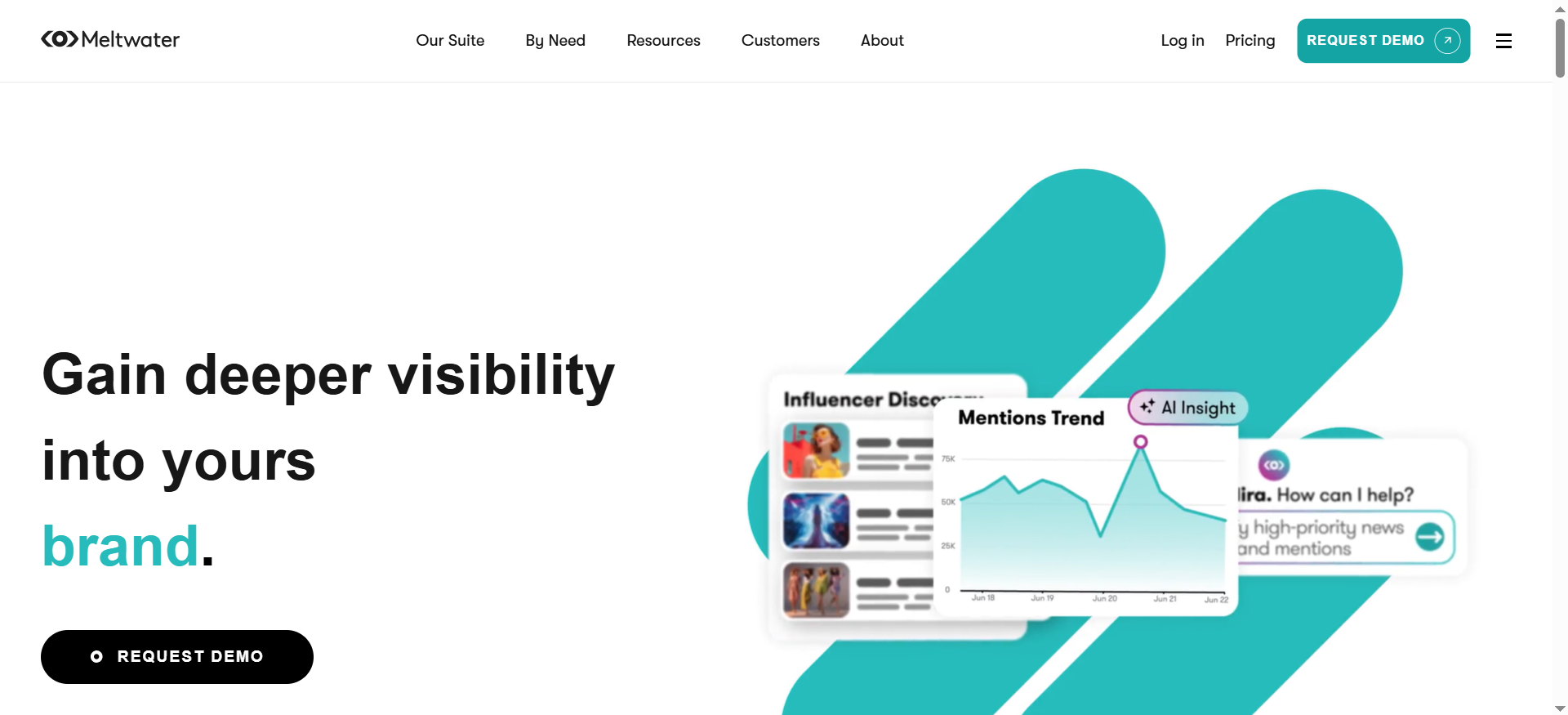
Meltwater is an enterprise media intelligence platform that monitors over 6 million different media sources worldwide. It covers online news, print newspapers, magazines, broadcast television, radio, podcasts, and social media platforms. The platform provides a unified dashboard for tracking brand mentions, analyzing media coverage trends, and measuring the impact of PR and communications efforts.
Why Teams Use It
Teams choose Meltwater because of its depth in traditional media monitoring. While many tools focus primarily on social media and web mentions, Meltwater was built from the ground up as a news monitoring platform. Its heritage in press clipping and media intelligence means it captures coverage from sources that newer social-first tools often miss — regional newspapers, trade publications, broadcast segments, and wire services.
What It Is Good For
Meltwater excels at comprehensive news monitoring across geographies and media types. The platform's strength is its ability to surface mentions from hard-to-reach sources like local print publications, niche industry journals, and broadcast media. Its GenAI Lens feature now tracks how brands appear in LLM-generated content, which is increasingly important as AI-powered search engines reshape how news is surfaced and consumed.
When It Is a Good Fit
Meltwater works best for mid-market to enterprise organizations with dedicated PR or communications teams that need to monitor coverage across multiple regions, languages, and media types. If your brand operates globally and you need a single platform that captures everything from a mention in a regional German newspaper to a segment on CNBC, Meltwater is built for that breadth.
When It Is Not a Good Fit
Meltwater is not ideal for early-stage startups or small teams with limited budgets. The platform requires annual contracts and the pricing scales significantly based on modules, users, and geographic coverage. If you only need to track online mentions and social media conversations, Meltwater's comprehensive media suite may be more than you need and more than you want to pay for.
How to Use It
After onboarding with a Meltwater product specialist, you set up monitoring dashboards by defining your brand keywords, competitor names, and industry terms. The platform delivers real-time alerts via email or in-app notifications when new mentions are detected. You can build custom reports, set up automated briefings, and use the analytics suite to measure share of voice, sentiment trends, and media reach over time.
Key Capabilities
Meltwater's core capabilities for news monitoring include real-time monitoring across 6M+ sources, unlimited keyword searches and boolean query support, GenAI Lens for tracking LLM and AI search mentions, automated media briefings and shareable reports, sentiment analysis and competitive benchmarking, journalist and influencer identification tools, predictive analytics for mention forecasting, and API access for custom integrations.
Pricing
Meltwater uses custom pricing based on the modules you select (media monitoring, social listening, influencer marketing, analytics), number of users, geographic scope, and contract length. The median annual cost is approximately $25,000, though entry-level configurations start around $6,000 per year for smaller teams with basic monitoring needs. Enterprise deployments with full suite access can exceed $100,000 per year. Multi-year agreements typically yield 10-20% discounts.
Free Tier?
No. Meltwater does not offer a free tier or self-serve trial. You can request a guided demo with a product specialist to evaluate the platform before committing.
Downsides and Limitations
Meltwater's pricing is opaque and requires a sales conversation, which makes it difficult to budget without going through the quote process. The platform's breadth can also be a downside — teams that only need news monitoring may find themselves paying for social listening, influencer tools, and analytics modules they do not use. Some users report that the learning curve is steeper compared to simpler monitoring tools, and the annual contract requirement means there is limited flexibility to scale down mid-term.
Tool #2: Cision
What It Does
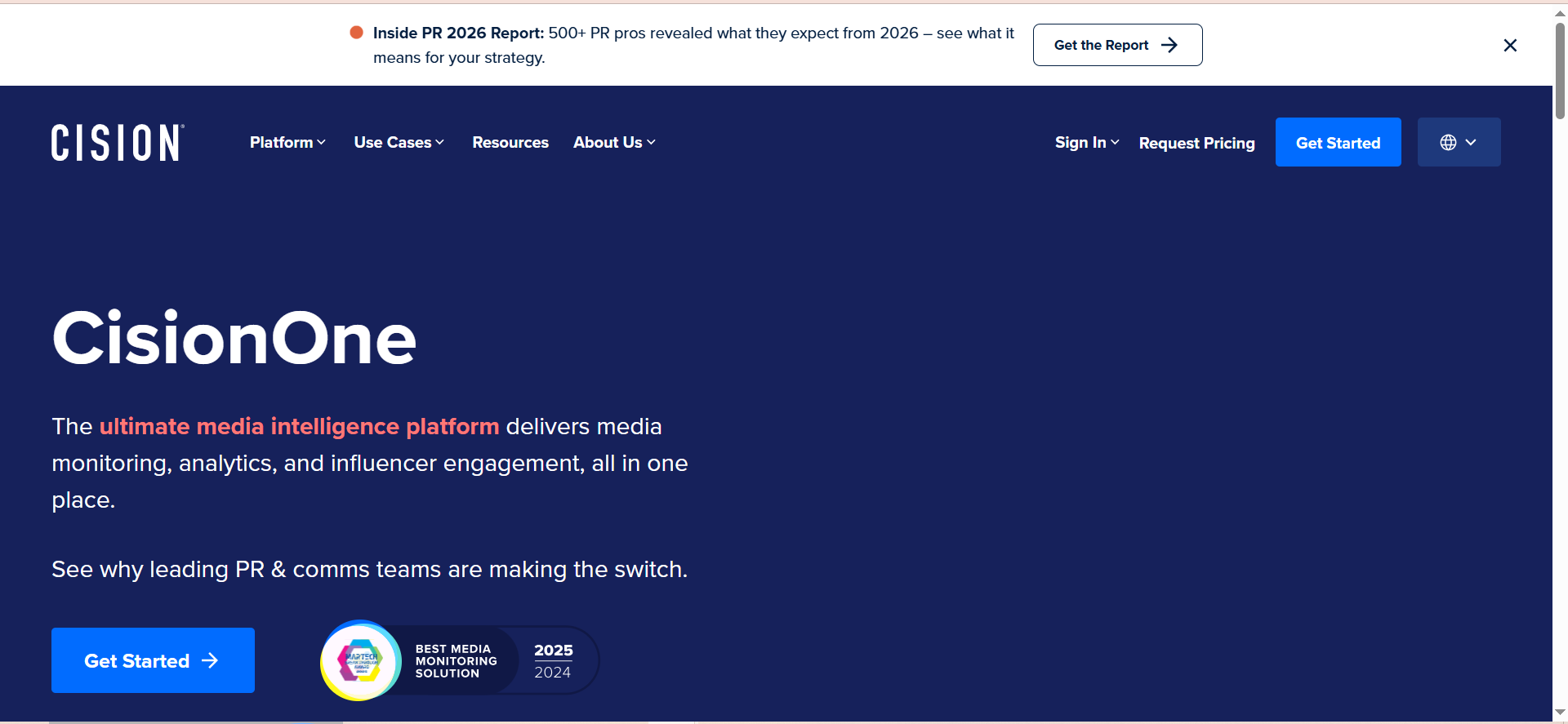
Cision, through its CisionOne platform, combines AI-powered media monitoring with journalist outreach and press release distribution (via PR Newswire). It tracks brand mentions across online news, print, broadcast TV, radio, and social media in over 190 countries and 96 languages. The platform is designed specifically for PR and communications professionals who need monitoring, outreach, and measurement in a single workflow.
Why Teams Use It
Teams choose Cision because it integrates media monitoring directly with a journalist database and press distribution network. Instead of using one tool to find coverage and another to pitch journalists, Cision puts both capabilities in the same platform. This tight integration between monitoring and outreach makes it particularly valuable for PR teams that need to track coverage of their own press releases and earned media efforts.
What It Is Good For
Cision is strongest when you need to connect the dots between outreach and coverage. The platform can track a press release from distribution through to pickup across news outlets, letting you measure which journalists covered your story and how far the coverage reached. Its AI-powered Mention Streams surface relevant coverage in real time, and the smart alerting system helps teams prioritize high-impact mentions over noise.
When It Is a Good Fit
Cision is a good fit for established PR and communications departments that actively pitch journalists, distribute press releases, and need to measure earned media impact. It works well for organizations that already use or plan to use PR Newswire for distribution, since the integration is native. Companies with media relations as a core function will get the most value from having monitoring and outreach unified.
When It Is Not a Good Fit
Cision is not ideal if your primary need is social listening or consumer sentiment analysis. While it includes social monitoring, it is fundamentally a PR and media relations platform. Teams that do not actively pitch journalists or distribute press releases will be paying for capabilities they do not use. Smaller teams may also find the pricing challenging, as all subscriptions require annual contracts and the per-user cost can add up quickly.
How to Use It
You start by configuring Mention Streams with your brand keywords, competitor names, and industry topics. CisionOne surfaces matching coverage in real-time feeds that you can filter by source type, geography, language, and sentiment. From the same platform, you can search the journalist database, build media lists, send pitches, and track which journalists open and engage with your outreach. Reports can be generated on demand or scheduled for automatic delivery.
Key Capabilities
Cision's key capabilities include AI-powered Mention Streams with real-time news tracking, full-text article access from thousands of global publications, smart alerting with customizable notification rules, integrated journalist database with verified contact information, PR Newswire press release distribution, coverage tracking from distribution through pickup, AI-generated coverage summaries, and mobile apps for iOS and Android.
Pricing
Cision does not publish standard pricing. Based on reported user purchases, the median annual cost is approximately $12,677. Entry-level packages for a single user with basic media monitoring start around $6,000 per year. More comprehensive configurations with multiple users, expanded monitoring, and outreach tools can range from $15,000 to $30,000+ per year. All CisionOne subscriptions are annual contracts.
Free Tier?
No. Cision does not offer a free tier. Demo access is available by request.
Downsides and Limitations
Cision's pricing varies significantly between similar configurations, and users report that quote consistency can be an issue. The platform's focus on PR workflows means teams looking primarily for news monitoring without outreach capabilities may find it overbuilt. Some users note that the journalist database, while extensive, requires regular verification since contact details can become outdated. The annual contract requirement and lack of monthly billing options reduce flexibility for teams with changing needs.
Tool #3: Muck Rack
What It Does
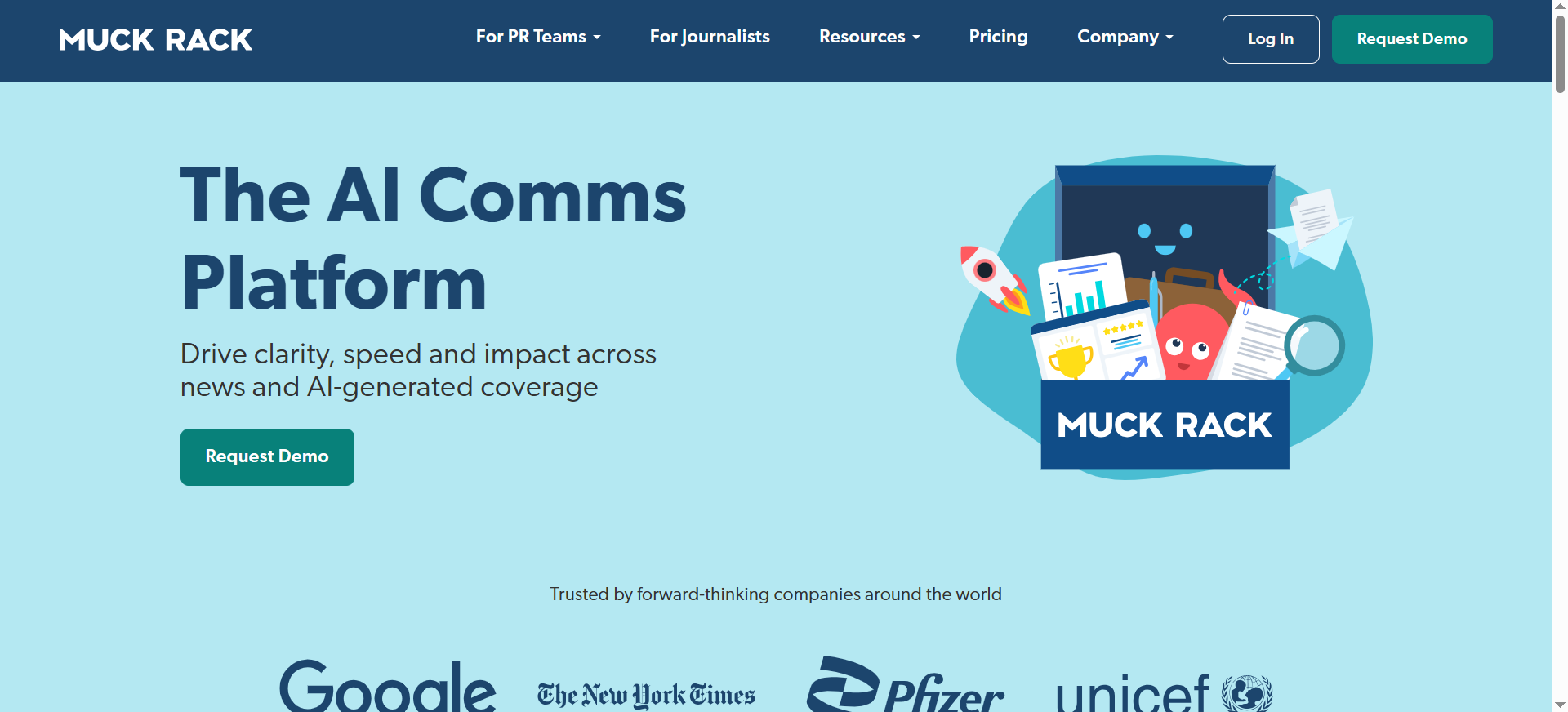
Muck Rack is a public relations management platform that combines a media database, journalist discovery engine, media monitoring, and reporting tools. It monitors brand mentions across print publications, broadcast media (through a partnership with TVEyes), online news sites, and social media platforms. The platform is designed to support the full PR workflow from finding journalists and pitching stories to tracking coverage and measuring results.
Why Teams Use It
Teams choose Muck Rack because of its journalist-centric approach to PR and monitoring. The platform maintains continuously refreshed journalist profiles that include verified contact information, recent coverage history, and topical focus areas. This makes it easier to identify the right journalists for a story and then track whether they cover it. The media monitoring component feeds directly into relationship management, creating a closed loop between outreach and coverage tracking.
What It Is Good For
Muck Rack is strongest at connecting journalist relationship management with media monitoring. The platform captures full article text from thousands of print and online publications worldwide and provides access to TV and radio clips through its TVEyes integration. For PR teams that need to demonstrate coverage results to stakeholders, Muck Rack's reporting tools make it straightforward to build coverage reports that show reach, sentiment, and media impact.
When It Is a Good Fit
Muck Rack is a good fit for in-house PR teams and agencies that actively manage journalist relationships and need monitoring as part of a broader PR workflow. It works particularly well for teams that value having journalist profiles directly alongside monitoring results, so they can see who covered their brand and immediately understand that journalist's beat, publication, and past coverage patterns.
When It Is Not a Good Fit
Muck Rack is not the right choice if your primary need is broad consumer sentiment analysis, social listening, or monitoring at massive global scale. While it covers news and social mentions, it does not match the source breadth of platforms like Meltwater or Talkwalker. Teams outside of PR and communications — for example, marketing analytics teams focused on social conversation trends — will find the journalist-centric features less relevant.
How to Use It
You set up monitoring by creating search queries with your brand name, competitor names, and relevant industry terms. Muck Rack delivers alerts when new coverage is detected across its monitored sources. From the monitoring dashboard, you can click through to full articles, see which journalists wrote the coverage, and add those journalists to media lists for future outreach. Reports can be customized and exported to share with stakeholders.
Key Capabilities
Muck Rack's key capabilities include a continuously updated media database with verified journalist contacts, full-text article access from thousands of print and online publications, broadcast monitoring through TVEyes partnership (TV and radio clips), social media mention tracking across major platforms, press release drafting and distribution from within the platform, AI-powered insights and customizable reporting (Premier tier), automated coverage alerts and media briefings, and team collaboration tools for managing pitches and relationships.
Pricing
Muck Rack uses a sales-led pricing model. Entry-level access starts around $5,000 per year for core journalist search and basic monitoring. Most teams operate in the $12,000 to $15,000 annual range, which includes expanded monitoring, more user seats, and advanced reporting. Larger deployments with AI features, full monitoring breadth, and multi-user access exceed $25,000 per year. Muck Rack offers separate plan tiers for brand customers and agency customers.
Free Tier?
No. Muck Rack does not offer a free monitoring tier. Journalists can create free profiles on the platform, but the monitoring and PR management tools require a paid subscription.
Downsides and Limitations
Muck Rack's news source coverage, while solid for major publications, does not match the breadth of dedicated media intelligence platforms like Meltwater or Talkwalker that monitor millions of sources globally. The platform's pricing is not publicly available, making it difficult to compare costs without going through a sales process. Some users report that broadcast monitoring through TVEyes, while useful, can lag behind real-time compared to print and online alerts. The platform is also US-centric in its journalist database, which may limit utility for teams focused heavily on international media.
Tool #4: Talkwalker
What It Does
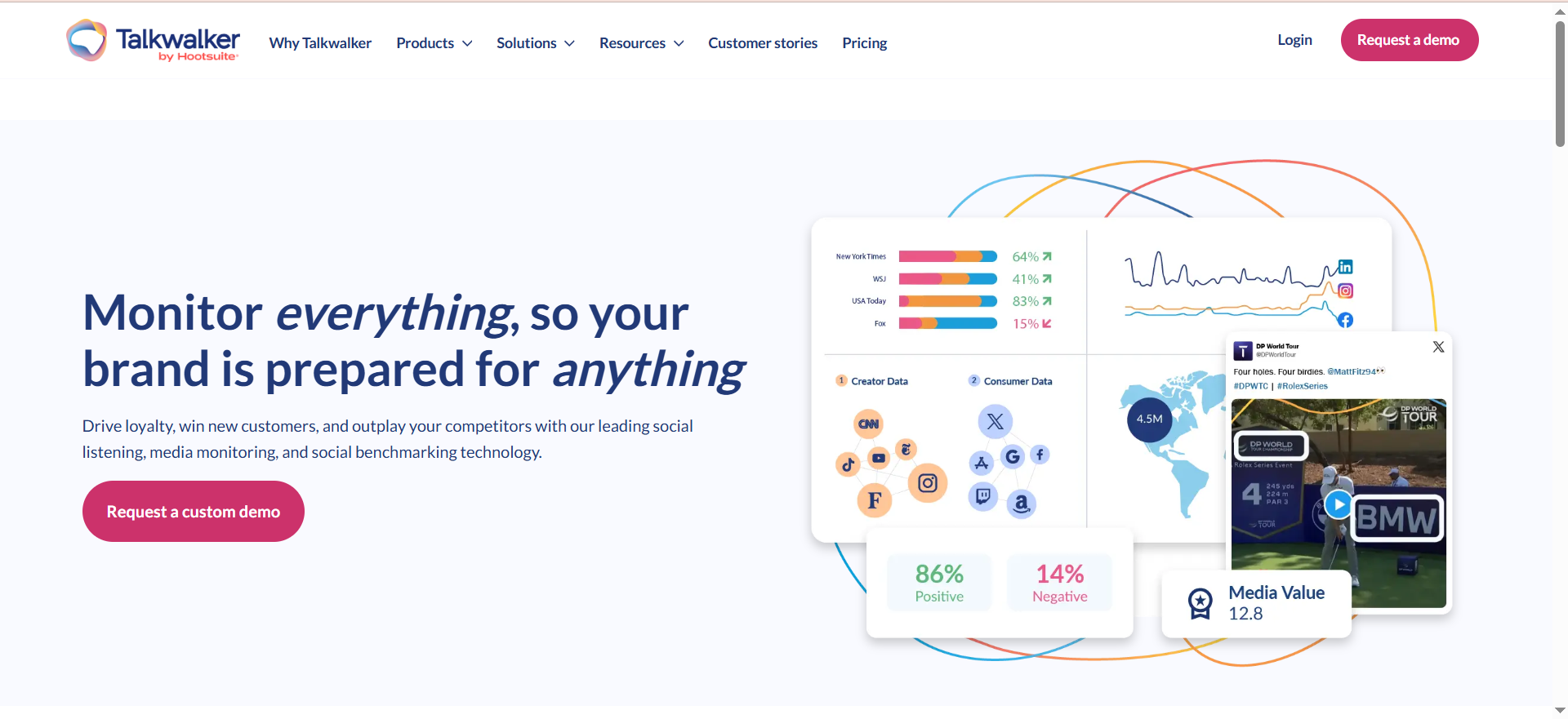
Talkwalker is a consumer intelligence and social listening platform, now part of Hootsuite, that monitors over 150 million sources including news sites, social media platforms, blogs, forums, review sites, print media, and broadcast channels. The platform uses AI-powered analytics to provide sentiment analysis, trend detection, and competitive benchmarking. Its visual listening capabilities can recognize brand logos and imagery in photos and videos, even when the brand is not mentioned in text.
Why Teams Use It
Teams choose Talkwalker for its combination of massive source coverage and advanced analytics capabilities. The platform goes beyond simple mention tracking by analyzing sentiment with high accuracy, recognizing brands in visual content, and providing consumer intelligence insights that help teams understand not just where they are mentioned but how public perception is shifting. The Hootsuite integration adds social management workflows for teams that need monitoring and publishing in the same ecosystem.
What It Is Good For
Talkwalker excels at large-scale brand monitoring across both news and social channels with a focus on deep analytics. Its visual listening feature is particularly valuable for brands with strong visual identities, as it can detect logo appearances in images posted across news articles and social media even when there is no text mention. The platform supports over 180 languages, making it one of the most globally capable monitoring tools available.
When It Is a Good Fit
Talkwalker is a good fit for enterprise marketing and PR teams that need global coverage, advanced sentiment analytics, and visual monitoring capabilities. It works particularly well for consumer-facing brands that generate significant visual media coverage — product photos, event imagery, sponsorship logos — where text-only monitoring would miss a substantial portion of brand appearances in news and social content.
When It Is Not a Good Fit
Talkwalker is not ideal for small teams or organizations with limited budgets. The platform is priced for enterprise use and the feature set can be overwhelming for teams that simply need basic news alerts. If your primary need is journalist relationship management or press release distribution, Talkwalker does not offer those PR-specific workflows — you would need to pair it with a tool like Cision or Muck Rack.
How to Use It
You configure monitoring by setting up topics with brand keywords, competitors, and industry terms. Talkwalker builds real-time dashboards that visualize mention volume, sentiment trends, source distribution, and geographic spread. The platform delivers alerts for mention spikes or sentiment shifts, and you can drill into individual mentions to see the full context. Visual listening is configured by uploading brand logos and visual assets for the AI to recognize across image and video content.
Key Capabilities
Talkwalker's key capabilities include monitoring across 150M+ sources in 180+ languages, AI-powered sentiment analysis with high accuracy, image and video recognition for visual brand monitoring, real-time dashboards with customizable visualizations, competitive benchmarking and share of voice analysis, crisis detection with automated spike alerts, consumer intelligence and trend analysis, Hootsuite integration for unified social management, and API access for custom data pipelines.
Pricing
Talkwalker uses a tiered pricing model. The Core plan starts at approximately $6,000 per year ($500/month). Mid-tier plans with expanded source access, more users, and advanced analytics features range from $12,000 to $26,400 per year. Enterprise configurations with full visual listening, API access, and dedicated support are priced on a custom basis and typically exceed $30,000 per year.
Free Tier?
No. Talkwalker does not offer a free tier for its monitoring platform. A free social search tool with limited functionality is available for basic exploration.
Downsides and Limitations
Talkwalker's pricing puts it out of reach for smaller organizations, and the platform's enterprise positioning means the onboarding and configuration process can be time-intensive. While the visual listening feature is powerful, it works best for brands with distinctive, recognizable logos — brands with generic or text-heavy logos may see lower recognition accuracy. Some users report that the sheer volume of data and configuration options can be overwhelming without dedicated training, and the Hootsuite acquisition has introduced some uncertainty about the platform's independent roadmap.
Tool #5: Brandwatch
What It Does
Brandwatch is a consumer intelligence platform that monitors brand mentions across news sites, social media, blogs, forums, review sites, and other online sources in real time. The platform uses AI-driven analytics to provide sentiment analysis, audience insights, demographic breakdowns, and trend detection. Its image analytics capability can recognize brand logos in photos posted across the web, adding a visual monitoring layer beyond text-based tracking.
Why Teams Use It
Teams choose Brandwatch for its depth of consumer intelligence and analytics capabilities. Beyond simply tracking where a brand is mentioned, Brandwatch analyzes who is talking about the brand, what they are saying, how sentiment is shifting over time, and what broader consumer trends are emerging. This makes it valuable for teams that need to translate brand mentions into strategic insights rather than just maintaining a clip file.
What It Is Good For
Brandwatch is strongest at turning large volumes of unstructured mention data into actionable intelligence. The platform's analytics engine can segment mentions by audience demographics, geography, platform, and sentiment, helping teams understand the full context behind coverage patterns. Its collaborative tools enable multiple team members to contribute to monitoring workflows, and the centralized dashboard consolidates data from multiple sources into a single view.
When It Is a Good Fit
Brandwatch is a good fit for enterprise marketing and brand teams that need deep analytics alongside monitoring. It works particularly well for organizations that treat brand monitoring as a strategic intelligence function rather than a simple alerting service. Teams that need to present consumer insights to leadership — backed by data on sentiment trends, audience composition, and competitive positioning — will benefit from Brandwatch's analytics and reporting capabilities.
When It Is Not a Good Fit
Brandwatch is not ideal if your primary need is traditional news monitoring with print and broadcast coverage. While it covers online news and social mentions comprehensively, its heritage is in social and consumer intelligence rather than traditional media monitoring. Teams that need to track print newspaper mentions, broadcast TV segments, or wire service pickups may find gaps compared to dedicated media monitoring platforms like Meltwater or Cision. The pricing also starts relatively high, making it less accessible for smaller teams.
How to Use It
You begin by creating queries with your brand keywords, competitor names, and industry terms. Brandwatch builds real-time monitoring dashboards that display mention volume, sentiment, source breakdown, and trending topics. You can set up alerts for mention spikes, sentiment shifts, or specific keyword triggers. The platform's analytics tools let you build custom reports with visualizations that can be shared across teams or exported for stakeholder presentations.
Key Capabilities
Brandwatch's key capabilities include real-time monitoring across news, social, blogs, forums, and review sites, AI-powered sentiment analysis with granular emotion detection, image analytics with logo recognition in visual content, audience demographics and consumer profiling, competitive benchmarking and share of voice analysis, customizable dashboards and automated reporting, collaborative workflow tools for team-based monitoring, three product suites covering Consumer Intelligence, Social Media Management, and Influencer Marketing, and API access for custom integrations and data exports.
Pricing
Brandwatch does not publish list pricing; all contracts are custom-quoted. Reported pricing starts at approximately $800 per month ($9,600/year) for basic access. Mid-tier configurations typically range from $2,000 to $5,000 per month. Large enterprise deployments with full Consumer Intelligence suite access, multiple product bundles, and high query volumes can exceed $15,000 per month. Pricing depends on the product suites selected, number of social accounts and data sources, user seats, query volume, and contract term.
Free Tier?
No. Brandwatch does not offer a free monitoring tier. Demo access is available through sales.
Downsides and Limitations
Brandwatch's pricing is among the highest in the category, and the lack of published pricing makes it difficult to budget without engaging sales. The platform's strength in social and consumer intelligence comes at the cost of traditional media coverage depth — teams that need comprehensive print and broadcast monitoring will need to supplement Brandwatch with another tool. The platform's extensive feature set can be overwhelming for teams that need straightforward news monitoring without the consumer intelligence layer, and the onboarding process for the full suite requires significant time investment.
How Do Brand Mention Monitoring Tools Work?
Brand mention monitoring tools continuously crawl and index content from news websites, social media platforms, blogs, forums, and other online sources. They use keyword matching, boolean queries, and increasingly AI-powered natural language processing to identify mentions of your brand name, product names, executive names, and other configured terms. When a match is found, the tool logs the mention with metadata including the source, publication date, author, reach estimate, and sentiment classification. Most tools deliver real-time or near-real-time alerts via email, in-app notifications, or integrations with team communication platforms.
The sophistication varies between tools. Basic monitoring relies on exact keyword matching, while advanced platforms like Talkwalker and Brandwatch use AI to understand context, detect sentiment nuance, and even recognize brand logos in images. Enterprise platforms like Meltwater and Cision add layers of media intelligence — connecting mentions to journalist profiles, publication authority scores, and audience reach estimates.
What Is the Difference Between Media Monitoring and Social Listening?
Media monitoring and social listening overlap but serve different primary purposes. Media monitoring focuses on tracking coverage in news publications, broadcast media, print outlets, wire services, and online news sites. The goal is to know when and where your brand appears in editorial content — articles, segments, press pickups, and industry publications. Tools like Meltwater, Cision, and Muck Rack are built around this use case.
Social listening focuses on tracking and analyzing conversations happening on social media platforms, forums, review sites, and community spaces. The goal is to understand what people are saying about your brand, how sentiment is shifting, and what trends are emerging in your category. Tools like Brandwatch and Talkwalker started in social listening and have expanded into news monitoring.
The practical difference matters when choosing a tool. If your priority is knowing when a journalist writes about your brand in a news article, you need strong media monitoring. If your priority is understanding how thousands of consumers talk about your brand on social platforms, you need strong social listening. Most enterprise tools now offer both, but each tool still has a primary strength based on its heritage.
How to Set Up Real-Time News Alerts for Your Brand
Setting up effective real-time news alerts requires more than typing your brand name into a search box. Start by building a comprehensive keyword list that includes your exact brand name, common misspellings, abbreviations, product names, and key executive names. Use boolean operators to refine results — for example, combining your brand name with industry terms to filter out irrelevant matches if your brand name is a common word.
Next, configure your alert thresholds. Most monitoring tools let you set alerts for individual mentions, daily digests, or spike-based triggers that notify you only when mention volume exceeds a baseline. For crisis preparedness, set up separate high-priority alerts for mentions that combine your brand with negative sentiment or specific risk keywords. Finally, route alerts to the right people — PR teams need immediate notifications for press coverage, while marketing teams may prefer daily or weekly summaries of overall mention trends.
Why Is Sentiment Analysis Important for Brand Monitoring?
Sentiment analysis transforms raw mention counts into actionable intelligence. Knowing that your brand was mentioned 500 times in news articles last month is useful; knowing that 60% of those mentions carried negative sentiment about a specific product issue is critical. Sentiment analysis helps teams prioritize which mentions require immediate attention, track how public perception shifts after product launches or PR campaigns, and identify emerging reputation risks before they escalate.
The accuracy of sentiment analysis varies between tools. Basic tools use keyword-based sentiment scoring, which can misclassify sarcasm, nuanced criticism, or context-dependent language. Advanced platforms like Talkwalker and Brandwatch use AI models trained on large datasets to detect sentiment with higher accuracy, including the ability to distinguish between different emotions (anger, disappointment, excitement, satisfaction) rather than just positive, negative, and neutral classifications.
How to Measure the ROI of Media Monitoring
Measuring the ROI of media monitoring requires connecting monitoring outputs to business outcomes. Start by tracking share of voice — how your brand's news coverage volume and sentiment compare to competitors over time. This metric shows whether your PR and communications efforts are gaining ground in your category.
Next, correlate media mentions with downstream metrics. Track whether spikes in news coverage correspond with increases in branded search volume, website traffic, inbound inquiries, or sales pipeline activity. Most monitoring tools provide reach estimates and advertising value equivalency (AVE) scores, though AVE is increasingly considered an outdated metric. More meaningful ROI measurement comes from tracking specific outcomes: did a product launch mention in a tier-one publication drive measurable website visits? Did sustained positive coverage in industry publications correlate with improved win rates in competitive deals?
What Are the Best Free Tools to Monitor Brand Mentions?
While the five tools reviewed in this guide are all paid platforms, several free options exist for teams with limited budgets or basic monitoring needs. Google Alerts remains the most widely used free option — it sends email notifications when your configured keywords appear in Google's news index. The coverage is limited to what Google indexes and the alerting speed is not real-time, but it costs nothing and requires no setup beyond entering your keywords.
Other free or freemium options include social media platform native search tools, Talkwalker's free social search tool (limited functionality), and basic RSS feed monitoring for specific publications you want to track. The trade-off with free tools is always coverage breadth, alerting speed, and analytics depth. Free tools will catch major online mentions but will miss print coverage, broadcast mentions, and mentions in sources not indexed by the search engines they rely on.
How to Track Competitor Mentions in the News
Tracking competitor mentions follows the same workflow as monitoring your own brand, but with additional analytical layers. Set up monitoring queries for each competitor's brand name, product names, and key executives. Most tools let you create comparative dashboards that show your brand's mention volume and sentiment alongside competitors, giving you a real-time view of share of voice in your category.
Pay attention to the context of competitor mentions. Are they being covered for product launches, funding rounds, partnerships, executive hires, or negative events? This intelligence helps you anticipate competitive moves and identify opportunities. For example, if a competitor receives negative coverage for a product issue in your category, your team can prepare proactive messaging that positions your product as a reliable alternative. Tools like Meltwater and Cision offer built-in competitive benchmarking dashboards that automate much of this analysis.
What Features Should You Look for in a Media Monitoring Tool?
The most important features depend on your team's specific needs, but several capabilities are universally valuable. Source breadth is foundational — the tool should cover the news sources that matter to your industry, including online publications, print media, broadcast, and wire services. Real-time alerting is essential for crisis preparedness and time-sensitive communications.
Beyond the basics, look for accurate sentiment analysis (preferably AI-powered), boolean query support for precise filtering, customizable reporting for stakeholder communication, and integration capabilities with your existing tech stack. If journalist outreach is part of your workflow, prioritize tools with built-in media databases and contact management. For global brands, language coverage and geographic filtering become critical — tools like Talkwalker (180+ languages) and Meltwater (6M+ global sources) lead in this area.
How Does AI Improve Brand Mention Tracking?
AI has transformed brand mention tracking in several important ways. Natural language processing enables tools to understand the context of mentions rather than just matching keywords, reducing false positives and improving the relevance of results. AI-powered sentiment analysis can detect nuanced emotional tones in coverage, distinguishing between a passing mention and a detailed critique.
Visual AI, offered by Talkwalker and Brandwatch, extends monitoring beyond text by recognizing brand logos in images and videos. This captures mentions that text-only monitoring would completely miss — a photo of someone using your product, a logo visible in event coverage, or a product placement in a video. Predictive analytics, available in platforms like Meltwater, use AI to forecast mention trends and identify emerging topics before they peak, giving teams time to prepare responses or capitalize on positive momentum.
How to Create a Media Monitoring Report
An effective media monitoring report translates raw data into a narrative that stakeholders can act on. Start with an executive summary that highlights the key metrics for the reporting period: total mentions, sentiment breakdown, share of voice versus competitors, and any significant coverage events. Include the top mentions by reach or impact, with links to the original articles.
Structure the body of the report around the questions your stakeholders care about. For PR teams, this means coverage by publication tier, journalist engagement, and campaign-specific results. For executive leadership, focus on sentiment trends, competitive positioning, and any reputation risks that need attention. Most monitoring tools offer automated report builders that can generate these reports on a schedule. Customize the templates to match your organization's reporting cadence and format preferences, and include trend comparisons (week-over-week or month-over-month) to show directional movement.
Frequently Asked Questions
The best tool depends on your team's specific needs and budget. Meltwater offers the broadest traditional media coverage across 6M+ sources. Cision is strongest for teams that need monitoring integrated with journalist outreach and press distribution. Muck Rack is ideal for PR teams focused on journalist relationship management. Talkwalker excels at global coverage with visual monitoring capabilities. Brandwatch provides the deepest consumer intelligence and analytics.
Media monitoring tools in this category range from approximately $5,000 to over $100,000 per year depending on the platform, modules, number of users, and geographic scope. Entry-level configurations typically start between $5,000 and $10,000 per year. Mid-tier setups for growing teams range from $12,000 to $25,000 per year. Enterprise deployments with full suite access can exceed $50,000 per year. All five tools reviewed here require annual contracts and do not offer monthly billing.
Yes, though coverage depth varies. Meltwater has the most comprehensive print and broadcast monitoring built directly into its platform. Cision covers print and broadcast across 190+ countries. Muck Rack accesses broadcast monitoring through its TVEyes partnership. Talkwalker includes print and broadcast in its 150M+ source network. Brandwatch focuses primarily on online and social sources, with more limited traditional media coverage.
None of the five tools reviewed here offer free plans for media monitoring. All require paid subscriptions with annual contracts. For free alternatives, Google Alerts provides basic news mention tracking, and some platforms like Talkwalker offer limited free social search tools. However, free tools cannot match the source coverage, alerting speed, or analytics depth of paid enterprise platforms.
Most enterprise monitoring tools detect and alert on new mentions within minutes of publication for online sources. Real-time monitoring is standard for online news and social media across all five platforms reviewed. Print and broadcast monitoring typically has a longer lag — print articles may take hours to appear as they are digitized and indexed, and broadcast clips require transcription processing. Alerting speed also depends on your configuration; spike-based alerts trigger faster than scheduled daily digests.
Brand monitoring tracks mentions of your brand across all media types including news, print, broadcast, and social platforms. Social listening specifically focuses on analyzing conversations and sentiment on social media platforms and online communities. Tools like Meltwater and Cision lean toward traditional brand monitoring with strong news coverage. Brandwatch and Talkwalker lean toward social listening with added news monitoring capabilities. Most enterprise tools now offer both, but each has a primary strength.
Yes, all five tools support competitor monitoring. You can set up tracking queries for competitor brand names, product names, and executives alongside your own brand monitoring. Meltwater, Cision, Talkwalker, and Brandwatch all offer competitive benchmarking dashboards that compare your share of voice, sentiment, and coverage trends against competitors. This capability is included in standard subscriptions and does not typically require additional fees.