TL;DR
If you run a growing B2B SaaS company and your brand is starting to show up in conversations you did not initiate, you need a brand monitoring tool that can keep pace. The five platforms covered in this guide — Brandwatch, Talkwalker, Meltwater, Sprinklr, and Brand24 — represent the strongest options for teams that need scalable monitoring without outgrowing the tool every twelve months. Brand24 is the strongest entry point for mid-market teams that want fast setup and transparent pricing. Brandwatch and Meltwater are better fits once you have a dedicated insights or PR function. Talkwalker wins on multilingual visual AI coverage, and Sprinklr makes the most sense if you already live inside its unified CX platform. This guide breaks down each tool by what it does, who it fits, pricing, capabilities, and limitations so you can shortlist with confidence.
Best Scalable Brand Monitoring Tools for Growing Companies (Quick Comparison)
| Tool | Best For | Starting Price | Key Strength |
|---|---|---|---|
| Brandwatch | Enterprise consumer intelligence teams | ~$800/mo (custom) | Deep historical data and consumer intelligence AI |
| Talkwalker | Global multilingual monitoring | $500/mo | Visual AI (Blue Silk) and 180+ language coverage |
| Meltwater | PR and media-heavy organizations | ~$6,000/yr (custom) | Premium paywalled news source access |
| Sprinklr | Large enterprises needing unified CX | ~$35,000/yr (custom) | 30+ channel unified inbox with enterprise governance |
| Brand24 | Mid-market and growing SaaS teams | $149/mo (annual) | LLM mention tracking and transparent pricing |
1. Brandwatch
What It Does
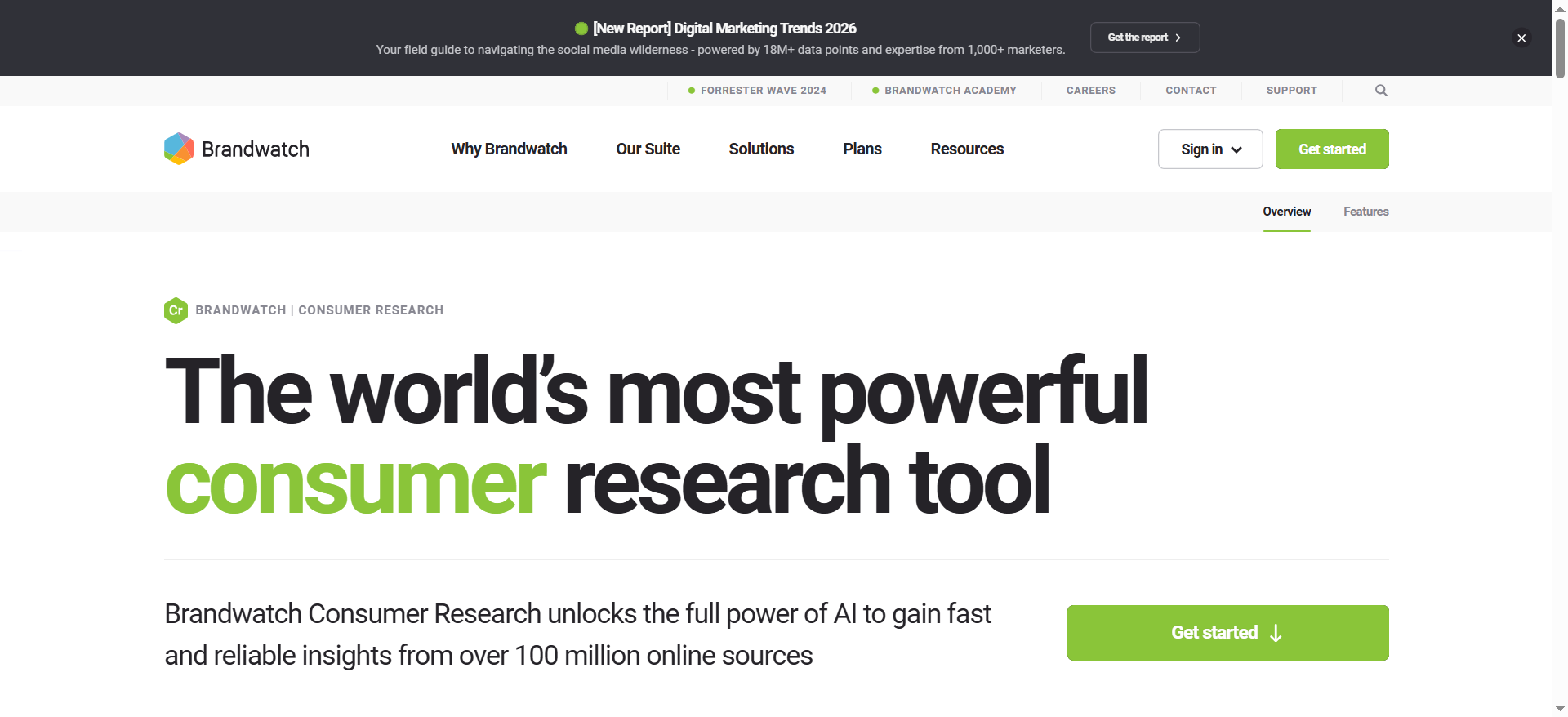
Brandwatch is a consumer intelligence platform that monitors online conversations across more than 100 million sources worldwide. It tracks mentions across social media, news outlets, blogs, forums, review sites, and the broader web, then layers AI-powered analytics on top to surface sentiment trends, audience insights, and competitive intelligence. The platform is built around three product suites: Consumer Intelligence, Social Media Management, and Influencer Marketing.
Why Teams Use It
Teams choose Brandwatch when they need deep, research-grade insight into what consumers are saying about their brand, their competitors, and their market. The platform goes beyond surface-level mention counting. Its Iris AI engine can identify emerging trends, detect anomalies in conversation patterns, and surface insights that would take a human analyst days to find manually. Brandwatch also offers image analytics that can recognize brand logos in photos posted on social media, even when the brand is not mentioned in the text of the post. For consumer brands with strong visual identities, this opens up a whole layer of monitoring that text-only tools miss entirely.
What It's Good For
Brandwatch excels at brand health tracking over time, competitive benchmarking across multiple product lines, crisis detection and real-time alerting, campaign performance measurement tied to conversation shifts, audience segmentation and persona research, and executive-level reporting with customizable dashboards.
When It's a Good Fit
Brandwatch makes the most sense for mid-to-large enterprises that need comprehensive social intelligence as part of a broader marketing and communications strategy. If you have a dedicated insights or analytics team, run regular brand health tracking, monitor multiple markets or product lines, or need to demonstrate ROI on marketing campaigns at scale, Brandwatch is one of the strongest platforms available. It fits well when the buying decision involves brand managers, consumer insights leaders, or CMOs who need more than mention volume — they need meaning behind the data.
When It's Not a Good Fit
If you are a small or early-stage team without a dedicated analyst, Brandwatch is likely overkill. The platform has a learning curve, the pricing is enterprise-grade, and you will not get full value from the consumer intelligence suite unless someone on your team is actively building queries, analyzing dashboards, and turning insights into action. Solo marketers or teams under ten people will find more accessible options elsewhere in this list.
How to Use It
Getting started with Brandwatch typically involves working with their sales team to scope the deployment. Once onboarded, you create monitoring queries (topics, brands, competitors), configure dashboards for different stakeholders, set up automated alerts for mention spikes or sentiment shifts, and schedule recurring reports. The platform integrates with tools like Hootsuite, Salesforce, and various BI platforms. Most teams take two to four weeks to get fully configured.
Key Capabilities
Brandwatch's core capabilities include AI-powered consumer intelligence with the Iris engine, image and logo recognition across social media, historical data archives going back over a decade, customizable dashboards and automated reporting, multi-market and multi-language monitoring, competitor benchmarking and share of voice analysis, crisis detection with real-time alerting, audience segmentation and demographic insights, and API access for custom integrations.
Pricing
Brandwatch uses fully custom pricing with no published rate card. Reported pricing starts around $800 per month and scales to $15,000 or more per month for large enterprise configurations. Pricing is based on the number of active queries (topics or brands monitored), data sources, user seats, and contract term. Annual contracts are standard, and multi-year commitments (two to three years) often unlock meaningful discounts. Each of the three product suites — Consumer Intelligence, Social Media Management, and Influencer Marketing — has its own pricing model.
Free Tier?
No. Brandwatch does not offer a free tier or a self-serve free trial. You need to go through their sales process to get access.
Downsides / Limitations
The biggest limitation is the price barrier for smaller teams. There is no self-serve option, no free trial, and the onboarding process requires meaningful time investment. Some users report that the interface, while powerful, has a steeper learning curve compared to lighter tools. The platform is also heavily weighted toward consumer brands and may not provide as much value for niche B2B SaaS companies with low public conversation volume.
2. Talkwalker
What It Does
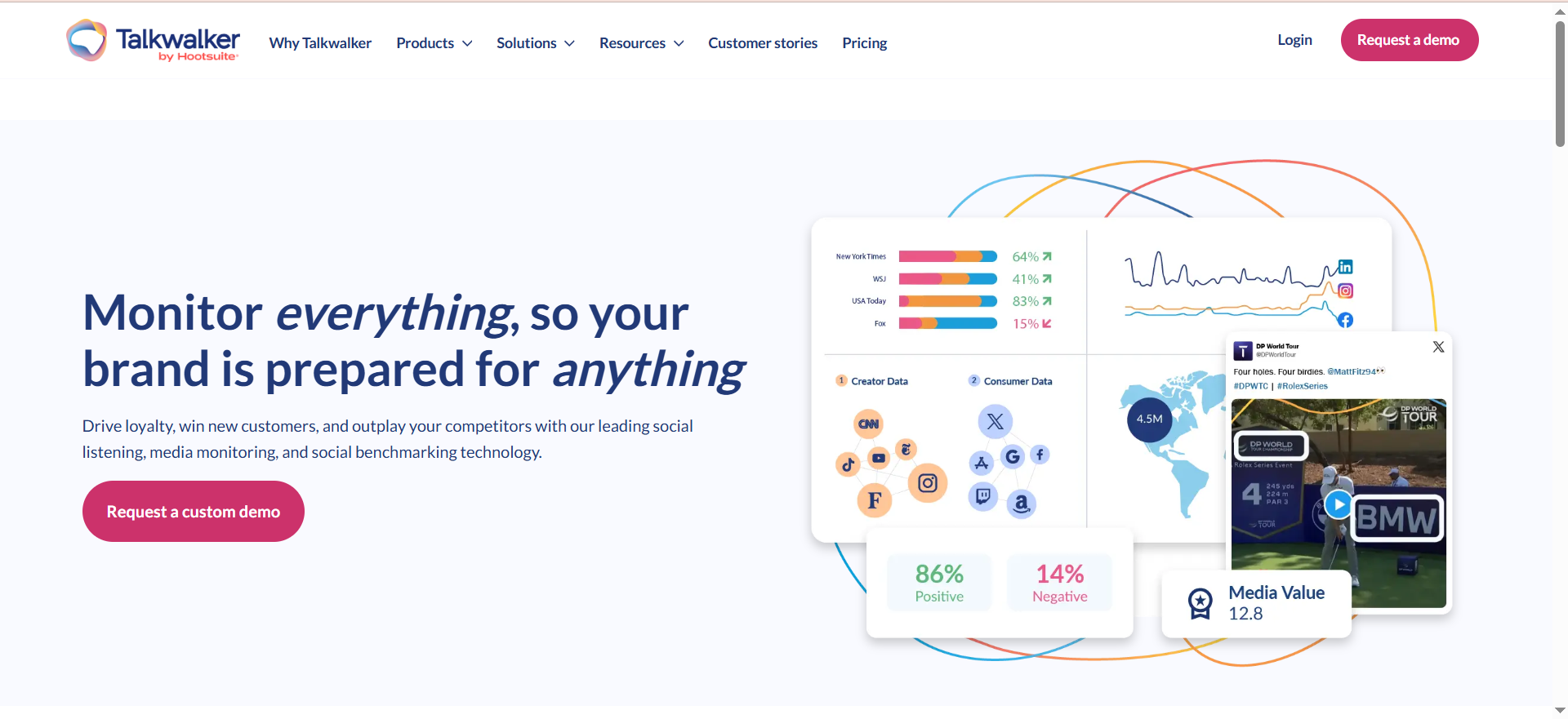
Talkwalker is a social media analytics and monitoring platform that tracks your online presence across social networks, websites, news outlets, and forums. It processes billions of daily conversations in over 180 languages to deliver insights about brands, campaigns, and market trends. Now part of the Hootsuite family, Talkwalker positions itself as a consumer intelligence accelerator with a strong emphasis on visual AI capabilities through its proprietary Blue Silk technology.
Why Teams Use It
Teams choose Talkwalker for its combination of deep multilingual coverage and advanced visual analysis. The Blue Silk AI engine goes beyond text, analyzing images, videos, and audio content to identify brand logos, product placements, and visual sentiment cues across platforms. This is particularly valuable for global brands that need to monitor conversations happening in dozens of languages simultaneously without relying on manual translation or region-specific tools.
What It's Good For
Talkwalker excels at global brand monitoring across 180+ languages, visual brand detection through image and video analysis, real-time crisis detection with instant alerting, competitive intelligence with benchmarking dashboards, campaign performance tracking tied to audience sentiment, and influencer identification and impact measurement.
When It's a Good Fit
Talkwalker fits best when your company operates across multiple international markets and needs a single platform that handles language diversity natively. If your brand has a strong visual identity and you want to track logo appearances in user-generated content, Talkwalker's visual AI is a genuine differentiator. It also works well for marketing and comms teams that want an enterprise-grade platform without the steeper learning curve of some competitors.
When It's Not a Good Fit
If your monitoring needs are primarily English-language and domestic, you may not get full value from the multilingual and visual AI features that justify Talkwalker's pricing. Small teams or startups on tight budgets may find the Basic plan limiting and the jump to Corporate or Enterprise steep. The platform also lacks a true self-serve free trial, which makes it harder to evaluate before committing.
How to Use It
After onboarding through the sales team, you set up monitoring topics, configure language and region filters, build custom dashboards, and create automated alerting rules. Talkwalker integrates with Hootsuite's social management suite, as well as CRM and BI tools. The platform offers a customizable dashboard where you can build views for different stakeholders — executives, PR, product teams — and schedule automated reports.
Key Capabilities
Talkwalker's core capabilities include Blue Silk AI for visual analysis of images, video, and audio, 180+ language processing and global coverage, AI-powered sentiment analysis with nuanced context detection, real-time alerts for critical brand mentions, competitive intelligence dashboards, influencer identification and tracking, customizable reporting and data visualization, and API access for custom workflows.
Pricing
Talkwalker offers three main pricing tiers. The Basic Plan starts at $500 per month ($6,000 annually) and includes core monitoring features. The Corporate Plan costs $1,000 per month ($12,000 annually) with expanded capabilities. The Enterprise Plan runs $2,200 per month ($26,400 annually) for the full feature set. Custom pricing is available for organizations with specialized requirements or very high volume needs.
Free Tier?
No. Talkwalker does not offer a free tier. You can request a guided demo, but there is no self-serve trial period.
Downsides / Limitations
The pricing structure can be steep for small businesses and startups, especially the jump from Basic to Corporate. Some users report that while the visual AI is impressive, the text-based sentiment analysis can occasionally miss nuance in certain languages or industry-specific jargon. The integration with Hootsuite, while beneficial for social management, may feel redundant if you already have a social publishing tool in your stack.
3. Meltwater
What It Does
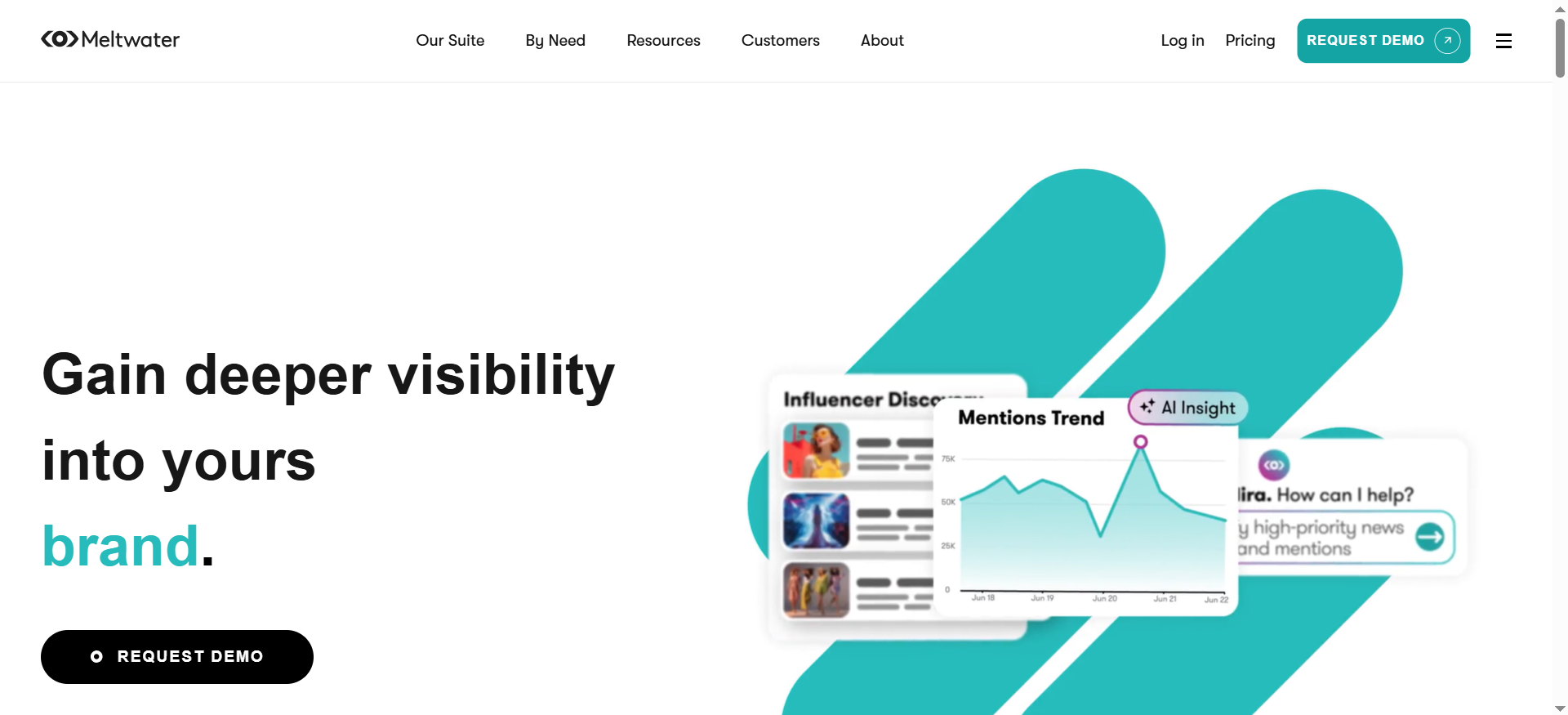
Meltwater is a media intelligence platform that combines media monitoring, social listening, influencer marketing, and analytics into a unified suite. It monitors more than 6 million media sources globally, including a significant differentiator: access to premium, paywalled news content from outlets like Bloomberg, Dow Jones, and Factiva. The platform is built to serve PR, communications, and marketing teams that need to track earned media alongside social conversations.
Why Teams Use It
Teams choose Meltwater when their brand monitoring needs extend beyond social media into traditional media, print, and broadcast coverage. If your PR team needs to track how your brand appears across both social platforms and major news outlets in a single view, Meltwater does this better than most competitors. The platform also includes a journalist and influencer database (powered by Klear) that helps comms teams identify and build relationships with relevant media contacts.
What It's Good For
Meltwater excels at combined media and social monitoring in a single platform, tracking brand mentions across paywalled news sources, journalist identification and media relationship management, competitive benchmarking across earned media, real-time alerting with unlimited search queries, executive reporting with shareable dashboards, and GenAI Lens for LLM tracking to monitor how AI models reference your brand.
When It's a Good Fit
Meltwater is the strongest fit for organizations where PR and media relations are a core function. If your team regularly tracks press coverage, monitors industry publications, manages journalist relationships, or needs to report on earned media value, Meltwater's media intelligence layer is hard to replicate with other tools. It also works well for growth-stage B2B SaaS companies that are starting to generate significant press coverage and need to understand their media footprint.
When It's Not a Good Fit
If your monitoring needs are purely social media focused and you do not care about traditional media coverage, Meltwater may include more than you need, and the pricing reflects that breadth. Teams that need deep consumer intelligence and audience segmentation may find Brandwatch or Talkwalker stronger in those specific areas. The lack of a free trial also makes it harder to test before committing.
How to Use It
Meltwater onboarding starts with a consultation to scope your monitoring needs. From there, you configure search queries, set up media monitoring feeds, build dashboards for different teams (PR, marketing, executive), create automated alerts, and integrate with your existing CRM or project management tools. The platform includes a journalist database you can use for outreach directly from the interface.
Key Capabilities
Meltwater's core capabilities include monitoring across 6 million+ media sources globally, access to premium paywalled news content (Bloomberg, Dow Jones, Factiva), Klear-powered journalist and influencer database, GenAI Lens for tracking brand mentions in LLM outputs, unlimited search queries across all plans, real-time alerts and automated reporting, competitive benchmarking and share of voice analysis, social listening across major platforms, and API access for custom integrations.
Pricing
Meltwater uses customized pricing based on modules selected, user count, data volume, and geographic coverage. The cost range runs from approximately $6,000 per year for smaller teams to $100,000+ for large enterprise deployments, with a median of around $25,000 per year. Meltwater offers three tiers: Essentials (core media monitoring and basic social listening), Suite (full feature set with advanced social management and analytics), and Enterprise (global coverage, heavy data usage, and dedicated support). Multi-year contracts typically yield 10 to 20 percent discounts compared to annual renewals.
Free Tier?
No. Meltwater does not offer a self-serve free trial. You can request a human-guided demo with a product expert.
Downsides / Limitations
The biggest limitation for growing companies is the pricing floor. Even the Essentials plan represents a meaningful investment, and the jump to Suite or Enterprise can be steep. Some users report that the interface, while comprehensive, can feel cluttered when you are using multiple modules simultaneously. The social listening capabilities, while solid, are not as deep as dedicated social intelligence platforms like Brandwatch when it comes to consumer research and audience analysis.
4. Sprinklr
What It Does
Sprinklr is a unified customer experience management (Unified-CXM) platform that includes brand monitoring as part of its broader suite covering social media management, customer service, marketing, and advertising. The Sprinklr Insights module specifically handles social listening, brand monitoring, competitive intelligence, and trend analysis across 30+ digital channels including social platforms, messaging apps, review sites, and forums.
Why Teams Use It
Teams choose Sprinklr when they want a single platform that handles the entire customer experience lifecycle, not just monitoring. The value proposition is consolidation: instead of running separate tools for social publishing, customer support, brand monitoring, and advertising, Sprinklr brings everything under one roof with shared data and unified reporting. For large enterprises that already use Sprinklr for other CX functions, adding brand monitoring is a natural extension that avoids data silos.
What It's Good For
Sprinklr excels at unified brand monitoring across 30+ channels in a single platform, enterprise-grade governance with compliance controls and approval workflows, AI-powered insights and trend detection, consolidated customer experience management (social, support, marketing, ads), competitive benchmarking with detailed share of voice analysis, real-time crisis management with coordinated response workflows, and executive dashboards that span the entire customer journey.
When It's a Good Fit
Sprinklr makes the most sense for large enterprises that need a comprehensive CX platform and are willing to invest in a single vendor strategy. If you have multiple teams (marketing, support, PR, social) that all need to monitor and respond to brand mentions, Sprinklr's unified approach eliminates the fragmentation that comes from using five different tools. It is particularly strong for regulated industries that need audit trails, approval workflows, and compliance controls built into their monitoring processes.
When It's Not a Good Fit
If you only need brand monitoring — not the full CX suite — Sprinklr is almost certainly more platform than you need, and the pricing reflects that. The platform has a reputation for complexity, and smaller teams without dedicated admins may struggle with the learning curve. The mention-based billing model (monthly quotas with overage fees after 70% usage) can create unpredictable costs. The BYOK (Bring Your Own Key) model for AI features, where you supply your own OpenAI or Azure API key and pay token costs separately, adds another layer of cost management.
How to Use It
Sprinklr implementation is typically a multi-week process involving their professional services team. Once configured, you set up listening topics, build moderation rules, create response workflows, configure dashboards for each team, and set up automated reporting. The platform integrates with major CRM, helpdesk, and marketing automation tools. Most enterprise deployments take four to eight weeks to fully operationalize.
Key Capabilities
Sprinklr's core capabilities include 30+ channel monitoring (social, messaging, reviews, forums), AI-powered sentiment analysis and trend detection, enterprise governance with compliance controls and audit logging, unified inbox for coordinated cross-team response, competitive intelligence and share of voice analysis, real-time crisis detection and management workflows, advanced reporting and customizable dashboards, integration with CRM, helpdesk, and marketing automation tools, and multi-language support across global markets.
Pricing
Sprinklr discontinued its self-service tier (previously $299 per user per month) as of April 30, 2026, and now operates on enterprise-only pricing. Enterprise plans start from approximately $35,000 per year, with the median annual cost for enterprise deployments at roughly $129,000 according to procurement data. Pricing is based on the number of users, modules selected, and mention volume quotas. The BYOK model for AI features means you pay the Sprinklr license plus your own token costs for OpenAI or Azure, effectively paying twice for the AI capabilities.
Free Tier?
No. Sprinklr does not offer a free tier or free trial. The previously available self-serve plan at $299 per user per month was discontinued as of April 30, 2026.
Downsides / Limitations
The primary downside is complexity and cost. Sprinklr is built for enterprise scale, and smaller or mid-market teams often find it over-engineered for their needs. The mention-based billing with quotas can lead to surprising costs if monitoring volume spikes unexpectedly. The BYOK model for AI features adds administrative overhead and cost unpredictability. Implementation timelines are longer than lighter tools, and the platform requires ongoing admin attention to maintain properly.
5. Brand24
What It Does
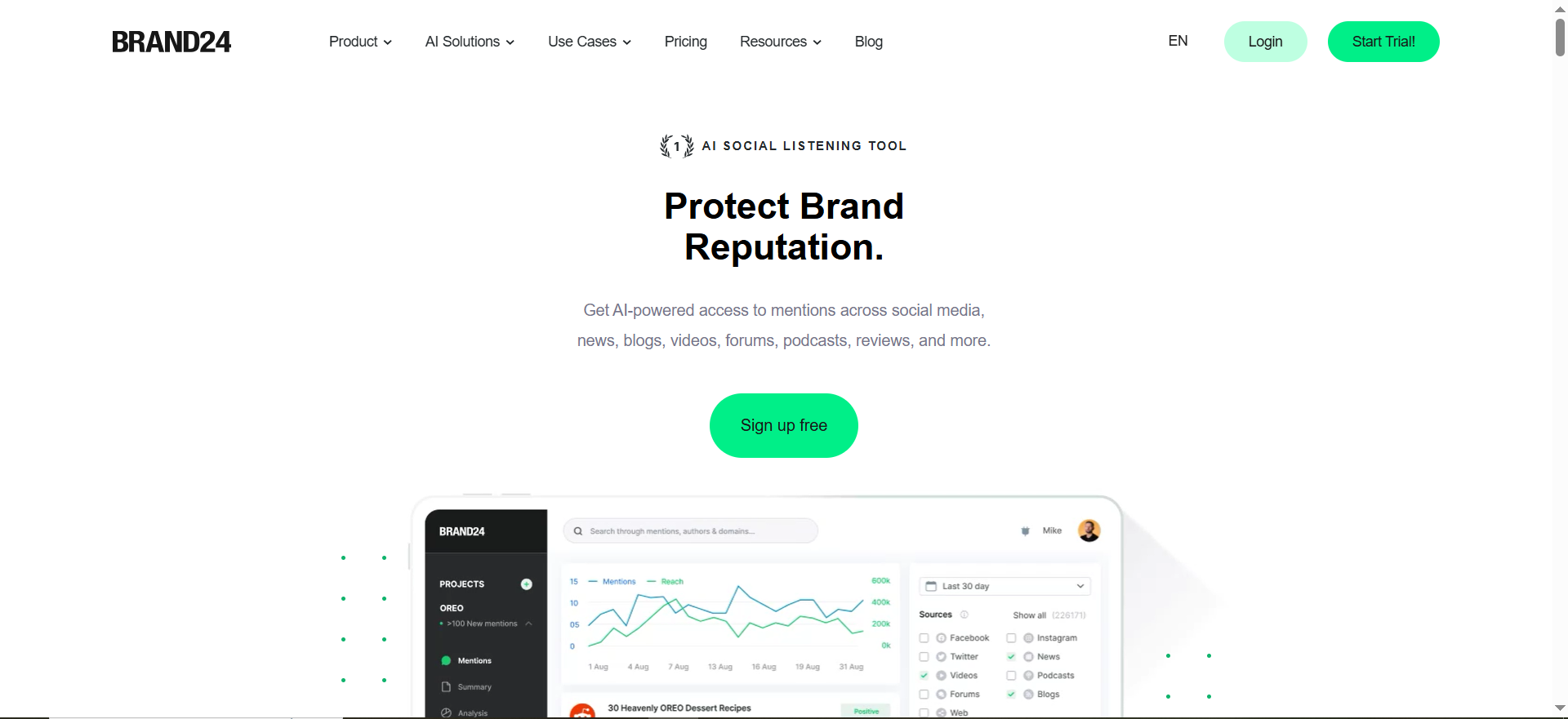
Brand24 is a social listening and brand monitoring platform that tracks mentions across social media, news sites, blogs, forums, review sites, podcasts, and video platforms. What sets it apart in 2026 is its LLM monitoring capability, which tracks how AI models like ChatGPT, Claude, Gemini, Perplexity, and others mention and recommend your brand. The platform is designed to deliver professional-grade monitoring at a price point accessible to growing companies and mid-market teams.
Why Teams Use It
Teams choose Brand24 because it delivers the monitoring coverage that most marketing and PR teams actually need without the enterprise complexity or six-figure contracts that come with larger platforms. The setup takes minutes, the dashboards are intuitive, and the pricing is transparent with published plans. The LLM monitoring feature is a genuine differentiator in 2026. As AI search engines and assistants become a significant source of brand discovery, knowing how ChatGPT, Claude, or Perplexity describe your product is no longer optional for growth-stage companies.
What It's Good For
Brand24 excels at real-time brand mention tracking across social and web, AI-powered sentiment analysis with context for each mention, LLM monitoring to track how AI models describe your brand, competitor monitoring and share of voice comparison, influencer identification based on mention reach and engagement, customizable alerts with flexible trigger conditions, and reporting with exportable dashboards and scheduled reports.
When It's a Good Fit
Brand24 is the strongest fit for mid-market and growing B2B SaaS companies that need professional brand monitoring without the enterprise overhead. If your team is between five and fifty people, you are generating enough online conversation to warrant monitoring, but you do not have a dedicated insights analyst, Brand24 sits in the practical sweet spot. It is also the only tool in this list that offers a genuine free trial (14 days, no credit card required), making it the easiest to evaluate before committing.
When It's Not a Good Fit
If you are a large enterprise that needs deep consumer intelligence, historical data archives going back a decade, or paywalled news monitoring, Brand24 does not compete with Brandwatch, Talkwalker, or Meltwater in those areas. The platform is strongest for mid-volume monitoring (up to 100,000 mentions per month on the top plan) and may not scale to the needs of global consumer brands monitoring millions of mentions across dozens of markets.
How to Use It
Brand24 setup is self-serve and takes just a few minutes. You create an account, enter your brand keywords (and competitor keywords), and the platform immediately starts pulling in mentions. From there, you configure alerts, customize your dashboard, and start exploring the data. The AI Brand Assistant lets you ask natural-language questions about your monitoring data, which is useful for quick insights without building custom queries. The platform also integrates with Slack and other tools for real-time notifications.
Key Capabilities
Brand24's core capabilities include mention tracking across social platforms (Instagram, X, TikTok, Reddit, LinkedIn, YouTube, Facebook, Quora, Telegram, Twitch), review sites (TripAdvisor, Yelp, Trustpilot, App Store, Google Play), news, blogs, and forums, AI-powered sentiment analysis (positive, negative, neutral) with context for each mention, LLM monitoring across ChatGPT, Claude, Gemini, Perplexity, DeepSeek, Grok, Copilot, and Google AI Overview, Share of Voice by AI Chatbots scoring, AI Brand Assistant for natural-language data queries, presence score and influence metrics, competitor monitoring and benchmarking, customizable reports and scheduled exports, and Slack integration for real-time alerts.
Pricing
Brand24 offers transparent, published pricing. The Individual plan costs $199 per month ($149 annually) and includes 3 keywords, 2,000 mentions per month, and 1 user with updates every 12 hours. The Team plan costs $299 per month ($249 annually) with 7 keywords, 10,000 mentions per month, unlimited users, and hourly updates. The Pro plan costs $399 per month ($299 annually) with expanded capabilities. The Enterprise plan costs $499 per month ($399 annually) and includes 25 keywords, 100,000 mentions per month, and real-time updates.
Free Tier?
Yes — Brand24 offers a 14-day free trial with no credit card required. This is unique among the five tools in this guide and makes it the easiest to evaluate before making a purchasing decision.
Downsides / Limitations
Brand24 does not offer the depth of consumer intelligence that Brandwatch provides, the paywalled news access that Meltwater includes, or the visual AI capabilities of Talkwalker. The mention volume caps on lower tiers can be limiting for fast-growing brands, and the 12-hour update interval on the Individual plan means you might miss time-sensitive mentions. Historical data depth is also more limited compared to enterprise platforms.
What Is Brand Monitoring and Why Does It Matter for Growing Companies?
Brand monitoring is the practice of tracking where and how your brand, products, competitors, and key industry terms are mentioned across the internet. This includes social media platforms, news outlets, blogs, forums, review sites, podcasts, and increasingly, AI-generated responses from large language models.
For growing companies, brand monitoring matters for several practical reasons. First, it gives you visibility into conversations you did not initiate. When customers talk about your product on Reddit, when a journalist mentions you in an article, or when a competitor references your pricing in their positioning — you need to know about it. Second, it provides early warning for reputation issues. A negative review thread that goes viral or a product complaint that picks up traction can be addressed in hours rather than days if you have monitoring in place. Third, it feeds your marketing and product strategy with real customer language. The way people describe your product in the wild is often different from how you describe it on your website, and that gap is valuable data.
For B2B SaaS companies specifically, brand monitoring also supports sales enablement. When a prospect mentions evaluating your category on LinkedIn or asks a question about your product type in a community forum, that is a signal your team can act on.
How to Choose a Brand Monitoring Tool for a Scaling Business
Choosing a brand monitoring tool when your company is actively scaling requires balancing current needs against future requirements. Here is a practical framework for narrowing the field.
Start with your monitoring scope. Define exactly what you need to track: your brand name, product names, key executive names, competitor brands, and relevant industry terms. Count the keywords — this directly affects pricing on platforms like Brand24 where plans are keyword-based. Next, assess your source requirements. If your brand is primarily discussed on social media and review sites, a tool like Brand24 or Talkwalker covers that well. If you need to track traditional media including paywalled sources, Meltwater becomes the stronger choice.
Consider your team size and technical capacity. Enterprise platforms like Brandwatch and Sprinklr deliver more power but require dedicated admin time and a steeper learning curve. If your marketing team is lean, a self-serve tool with fast setup is more valuable than a comprehensive platform that sits half-configured.
Evaluate the pricing model carefully. Some tools charge by mention volume (Sprinklr), others by keywords (Brand24), and others by modules and user seats (Meltwater, Brandwatch). Model your expected usage against each pricing structure to find the best fit. Finally, consider your growth trajectory. If you expect to triple your monitoring scope in the next twelve months, pick a platform that scales without forcing a complete migration.
Brand Monitoring vs Social Listening — What Is the Difference?
Brand monitoring and social listening are related but distinct disciplines. Brand monitoring is fundamentally about tracking — knowing when and where your brand is mentioned, by whom, and in what context. It answers the question: what are people saying about us right now? Social listening goes a layer deeper. It is about understanding the broader conversations, trends, and sentiment patterns in your market, not just mentions of your specific brand. Social listening answers the question: what does the market care about, and where do we fit?
In practice, most modern brand monitoring tools include social listening capabilities and vice versa. Brandwatch and Talkwalker are among the strongest at blending both disciplines. Brand24 focuses more on the monitoring side with some listening features. Meltwater bridges both but adds media intelligence on top. Sprinklr folds everything into its broader CX platform.
For growing companies, the practical recommendation is to start with monitoring (track your brand and competitors) and expand into listening (track category conversations and trends) as your team and strategy mature.
How Much Does Brand Monitoring Software Cost in 2026?
Brand monitoring software pricing in 2026 spans a wide range depending on the platform, features, and scale of your deployment. Here is a realistic cost breakdown based on current market data.
At the entry level, Brand24 offers the most accessible pricing with published plans starting at $149 per month (billed annually) for basic monitoring with limited keywords and mention volume. Mid-market teams typically spend between $249 and $399 per month on Brand24 or around $500 to $1,000 per month on Talkwalker's Basic or Corporate tiers.
At the enterprise level, costs escalate significantly. Brandwatch starts around $800 per month and scales to $15,000+ per month depending on configuration. Meltwater ranges from $6,000 to over $100,000 per year with a median around $25,000 annually. Sprinklr enterprise deployments average roughly $129,000 per year.
The key variables that drive pricing include the number of keywords or queries, mention volume caps, user seats, data source breadth, contract length (multi-year deals often save 10 to 20 percent), and which modules you need (monitoring alone vs. monitoring plus influencer marketing or social management).
Can Brand Monitoring Tools Track AI and LLM Mentions?
Yes, and this is one of the most important developments in brand monitoring for 2026. As AI search engines and assistants become mainstream sources of product discovery and recommendation, knowing how large language models describe your brand is becoming a critical intelligence layer.
Brand24 is the most transparent about this capability in our comparison. Its LLM monitoring feature tracks how AI models — including ChatGPT, Claude, Gemini, Perplexity, DeepSeek, Grok, Copilot, and Google AI Overview — mention and recommend your brand. It provides a Share of Voice by AI Chatbots score and can identify misinformation in LLM responses about your product.
Meltwater has introduced GenAI Lens, which tracks brand mentions across LLM outputs as part of its broader media intelligence suite. Brandwatch, Talkwalker, and Sprinklr are at various stages of adding AI visibility features, but Brand24 and Meltwater currently offer the most developed LLM tracking capabilities.
For B2B SaaS companies, LLM monitoring matters because an increasing percentage of your potential buyers are using AI assistants to research tools, compare products, and make shortlists. If an AI model consistently recommends your competitors but not you, that is a visibility gap that traditional SEO and social monitoring alone will not catch.
What Are the Key Features to Look for in Scalable Brand Monitoring Software?
When evaluating brand monitoring tools for a growing company, certain features matter more than others for scalability. Here are the capabilities that separate tools that scale from tools you will outgrow.
Real-time or near-real-time alerting is non-negotiable. You need to know about critical mentions within minutes, not hours. Check the update frequency on each pricing tier — Brand24's Individual plan, for example, only updates every 12 hours, while higher tiers offer hourly or real-time updates.
Sentiment analysis with context is more useful than simple positive/negative/neutral classification. Look for tools that explain why a mention was tagged with a particular sentiment, so your team can prioritize response efforts accurately. Multi-source coverage is essential for comprehensive monitoring. At minimum, your tool should cover major social platforms, news outlets, blogs, forums, and review sites. Bonus points for podcast monitoring, video platform tracking, and LLM mention tracking.
Scalable keyword and query management matters as your monitoring scope grows. A tool that limits you to three keywords on the entry plan will force an upgrade quickly. Evaluate the keyword-to-price ratio across tiers. Reporting and export capabilities should match your stakeholder requirements. If your CMO needs a monthly brand health dashboard and your PR team needs weekly media coverage reports, confirm that the tool supports multiple report templates and scheduled delivery.
How to Set Up Brand Monitoring Alerts That Actually Work
Effective brand monitoring alerts are specific enough to catch genuine signals without burying you in noise. Here is a practical approach to configuring alerts that deliver value.
Start with your critical alert triggers. These are the mentions that require immediate attention: sudden spikes in mention volume (often indicating a crisis or viral moment), mentions with strongly negative sentiment, mentions from high-authority sources (major publications, industry influencers), and direct customer complaints on public channels. Set these as real-time or highest-frequency alerts.
Layer in your daily digest alerts for ongoing tracking: competitor mentions, industry keyword trends, product feature discussions, and general brand sentiment patterns. These do not need immediate action but should land in your inbox or Slack channel for daily review.
Reduce noise by using negative keywords to filter out irrelevant mentions. If your brand name is a common word, add context qualifiers to your monitoring queries. Most enterprise tools (Brandwatch, Talkwalker, Meltwater) support Boolean query logic that lets you build precise filters. Brand24 and simpler tools rely more on keyword combinations and exclusion lists.
Test your alert configuration for two weeks before assuming it is dialed in. Adjust thresholds, add or remove keywords, and refine sentiment filters based on the actual signal quality you are receiving.
Brand Monitoring for B2B SaaS — What Is Different?
Brand monitoring for B2B SaaS companies has specific characteristics that distinguish it from monitoring for consumer brands. Understanding these differences helps you configure your tool correctly and set appropriate expectations.
First, mention volume is typically lower. A consumer brand like Nike generates millions of monthly mentions. A B2B SaaS company in the project management or data analytics space might generate hundreds or low thousands. This means your monitoring tool needs to be good at finding and surfacing every relevant mention, not just analyzing massive volumes.
Second, the channels that matter are different. For B2B SaaS, the highest-value mentions often come from LinkedIn, Reddit (especially subreddit communities), G2 and Capterra reviews, Hacker News, industry-specific Slack communities, and increasingly, AI search engines. Twitter/X matters less than it does for consumer brands. Make sure your tool covers B2B-relevant channels well.
Third, the definition of a meaningful mention is different. For B2B SaaS, a single post from a decision-maker evaluating your category on LinkedIn may be more valuable than a hundred casual mentions on Twitter. Look for tools that let you filter by source authority, commenter influence, and conversation context.
Fourth, competitive monitoring is often more actionable in B2B SaaS. Tracking what prospects say about your competitors — their complaints, feature requests, and pricing frustrations — directly feeds your sales and marketing strategy.
Free vs Paid Brand Monitoring Tools — When to Upgrade
Free brand monitoring options exist, but they come with significant limitations that growing companies will hit quickly. Google Alerts is the most common free option, and while it covers web mentions, it misses social media entirely, has significant latency, and provides no analytics.
The upgrade trigger is usually one of these situations: you need social media coverage (Google Alerts does not cover social platforms), you need sentiment analysis to understand whether mentions are positive or negative, you need competitor monitoring beyond basic web mentions, you need reporting capabilities to share insights with stakeholders, or your mention volume has grown beyond what manual tracking can handle.
For most growing B2B SaaS companies, the right time to invest in a paid tool is when you have enough brand awareness to generate regular mentions (even if just a few per day) and at least one person on your team responsible for marketing, PR, or brand strategy. At that point, a tool like Brand24 at $149 per month (annual billing) delivers enough value to justify the cost. The jump to enterprise tools ($500+ per month) makes sense when your monitoring scope expands to multiple products, multiple markets, or when you need media intelligence beyond social listening.
How to Measure ROI on Brand Monitoring
Measuring the return on investment for brand monitoring requires connecting monitoring data to business outcomes. Here is a practical framework for quantifying the value.
Track crisis prevention value by documenting instances where early alert detection allowed your team to address a negative mention, review, or press story before it escalated. Estimate the cost of a reputation crisis (lost deals, customer churn, PR spend) versus the cost of early intervention.
Measure competitive intelligence impact by tracking how monitoring-derived insights influenced your sales win rate, product roadmap, or positioning decisions. If monitoring revealed a competitor weakness that your sales team used to close three additional deals, that is quantifiable ROI.
Calculate media coverage value by using your monitoring tool's analytics to track earned media mentions. While advertising value equivalency is an imperfect metric, tracking the volume and quality of earned coverage over time provides a useful benchmark for PR team performance.
Assess customer sentiment trends as a leading indicator for churn. If your monitoring data shows declining sentiment three months before your churn rate increases, you have a predictive signal that justifies the monitoring investment. Report monthly on mention volume, sentiment ratio, share of voice versus competitors, and any specific actions taken based on monitoring insights. Tying monitoring directly to actions taken and outcomes achieved is the most convincing way to justify ongoing investment.